Seenaptec 1.7.0: From Access Control to a Unified Physical Security Platform
The update continues the development of Seenaptec as a universal platform for managing physical security across facilities — from individual rooms and offices to industrial enterprises, data centers, and distributed infrastructure.
In this article, we cover the key changes and the new opportunities they open up for customers and system integrators.
Access control and fire alarm systems — now in one system
Until recently, access control and fire alarm systems operated independently of each other at most facilities. One was responsible for doors, passes, and employee movements; the other — for fire detection, notification, and fire protection automation.
When an incident occurred, specialists had to work with several applications, match events by timestamp, and manually reconstruct what had happened.
In Seenaptec 1.7.0, these systems now share a common software environment.
The first supported fire alarm system is UniPOS IFS7000, used primarily in international markets. Seenaptec automatically detects connected equipment, receives the statuses of fire detectors and zones, reports alarms and malfunctions, and provides the operator with tools to manage the fire protection system.
During connection, an existing UniPOS project configuration can be imported. Instead of impersonal device numbers, the operator sees the familiar names of rooms, fire zones, and equipment.
How does it work in practice?
Imagine a data center where Seenaptec manages access to machine rooms and server cabinets.
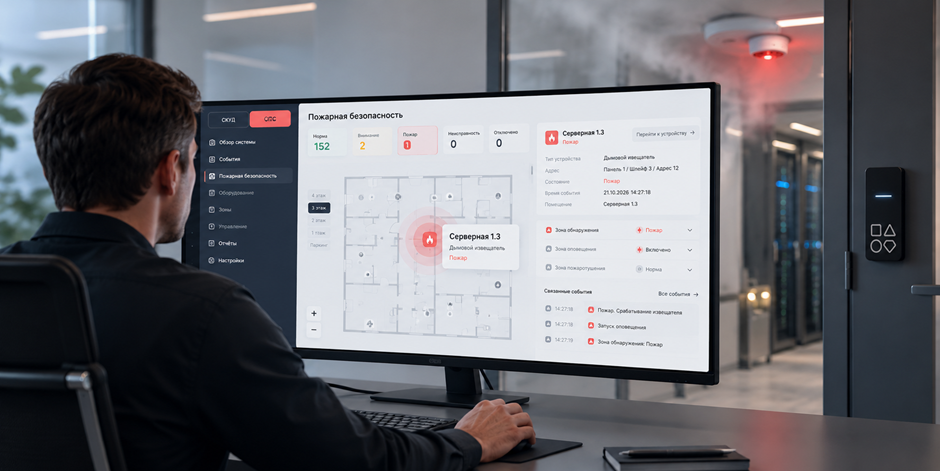
In one of the rooms, the fire alarm system registers an alarm. The operator sees where the event occurred, which detector triggered, and what state the fire protection equipment is in.
Right there in Seenaptec, the operator can access the access control events and find out who entered the room, which server cabinets were opened, and what actions were performed before the alarm.
As a result, the security team receives not just separate messages from different systems, but the ability to analyze the incident within a single platform.
This is especially important for facilities where it is necessary to monitor not only the fact that an alarm has been triggered, but also personnel actions, access to equipment, and compliance with operating procedures.
What's next: Bolid and Rubezh
UniPOS support is the first stage in the development of the new fire protection subsystem.
Upcoming Seenaptec updates are planned to include integration with equipment from the Russian manufacturers Bolid and Rubezh.
At the same time, the fire protection subsystem itself is not tied to a single manufacturer. The common principles remain the same: displaying equipment status, working with fire zones, managing operator permissions, and logging events.
For customers, this opens up the possibility of gradually consolidating their existing fire safety and access control systems in one software environment — without mandatory replacement of installed fire equipment, provided that the corresponding integration is supported.
In the long term, this approach will make it possible to build comprehensive solutions for enterprises, office buildings, data centers, and other facilities where access management and fire safety are parts of a common infrastructure.
Not just a shared interface: a unified event history and employee accountability
Combining different security systems creates a new challenge: not every operator should have the right to control all connected equipment.
For example, a badge office employee should be able to issue access cards, but there is no reason to allow them to disable fire zones. And a fire safety specialist may need to control the alarm system without having the authority to change employee access rights.
Seenaptec 1.7.0 introduces a new permission model that allows you to independently set rights for the access control system, the fire protection subsystem, and individual job functions.
What does this mean in practice?
At a large enterprise, you can set up a single security monitoring center while maintaining a division of responsibilities between departments.
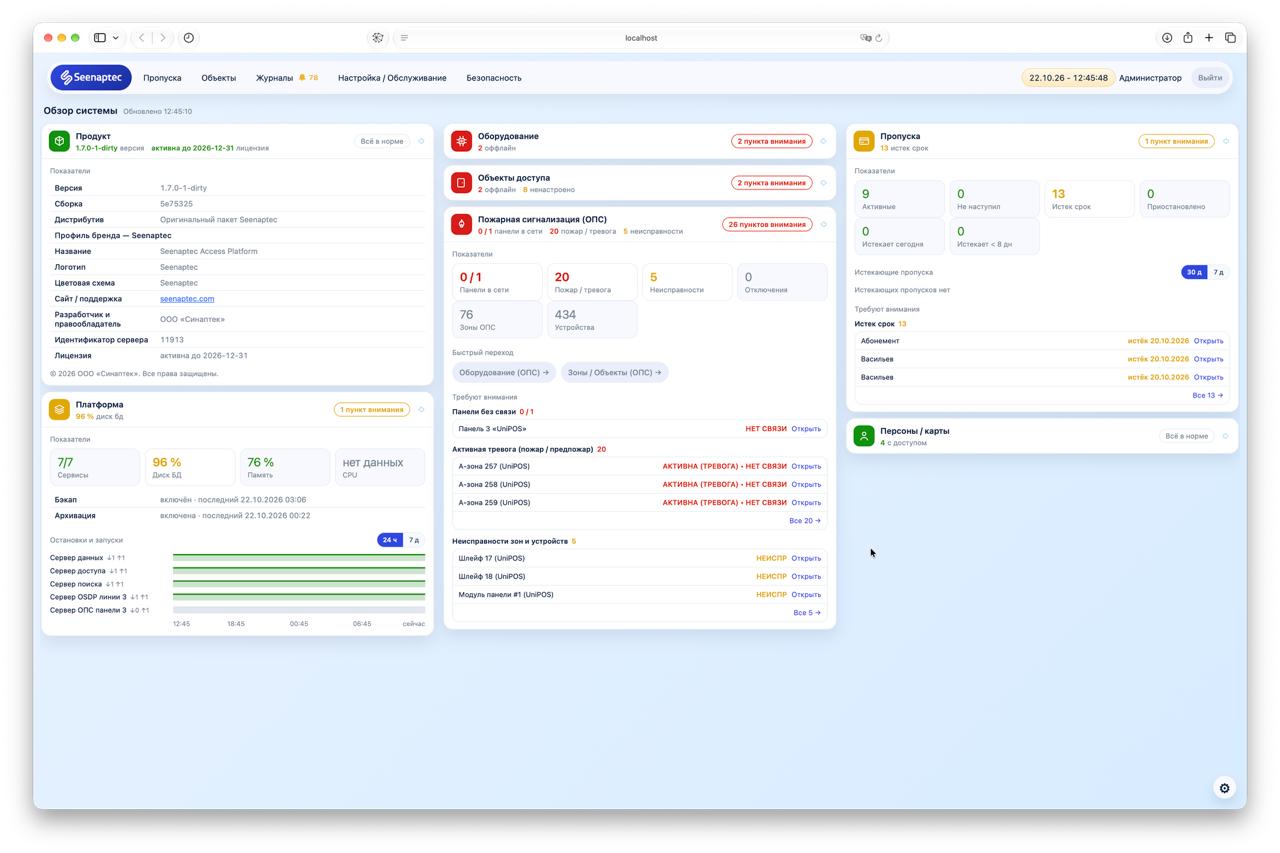
The on-duty operator monitors the status of the equipment. The security service manages access. Employees responsible for fire safety get the tools they need in the fire protection subsystem. The administrator determines which actions are allowed for each group.
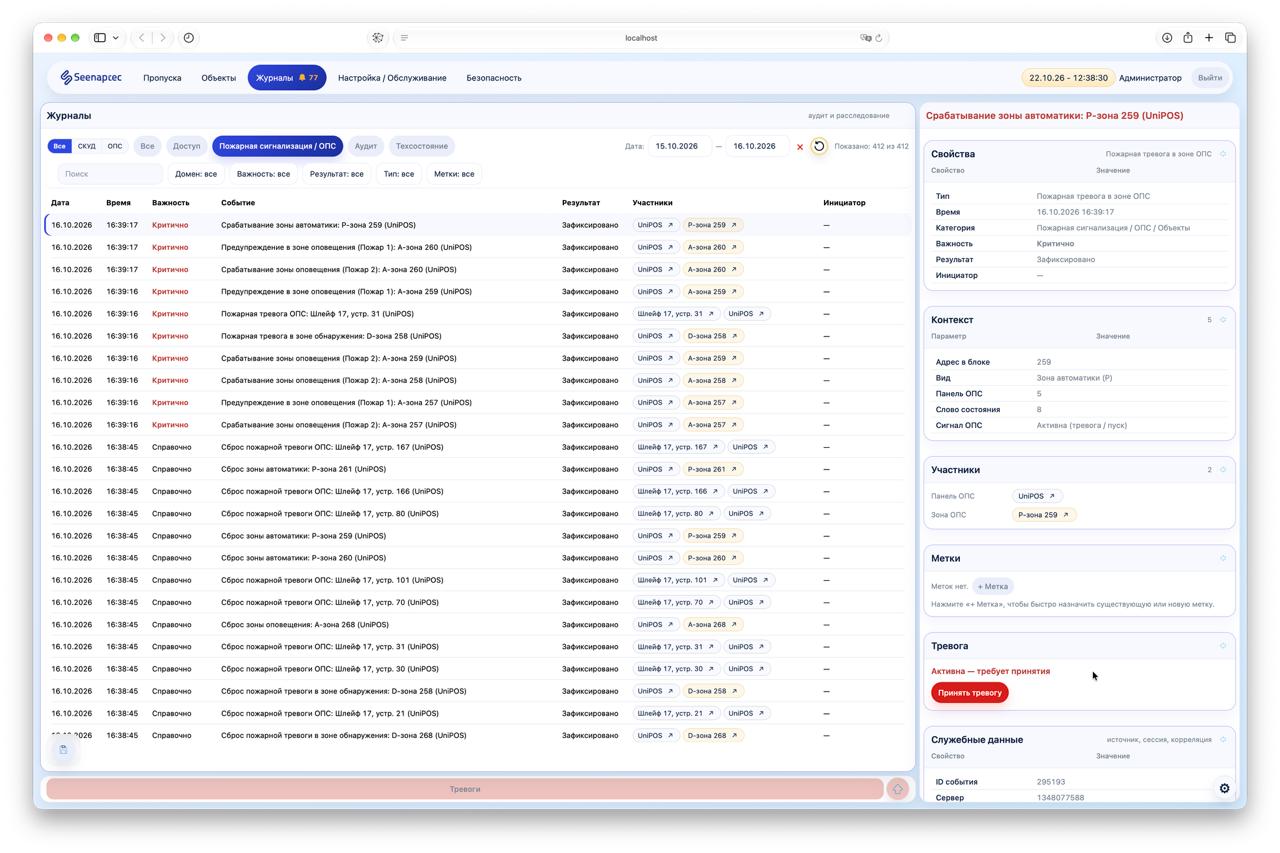
All events, including operator commands, are recorded in a common log with the ability to filter by subsystem and category.
This is useful not only for incident investigation, but also for internal audits, contractor oversight, and reviewing employee actions.
Configuring AGRG readers is now easier: just prepare special cards
Another important change concerns equipment commissioning.
Large facilities can use dozens or even hundreds of readers. Each of them must be configured to work with the credential types and security parameters adopted at the enterprise.
The new version of Seenaptec makes it possible to issue AGRG reader programming cards directly from the system interface.
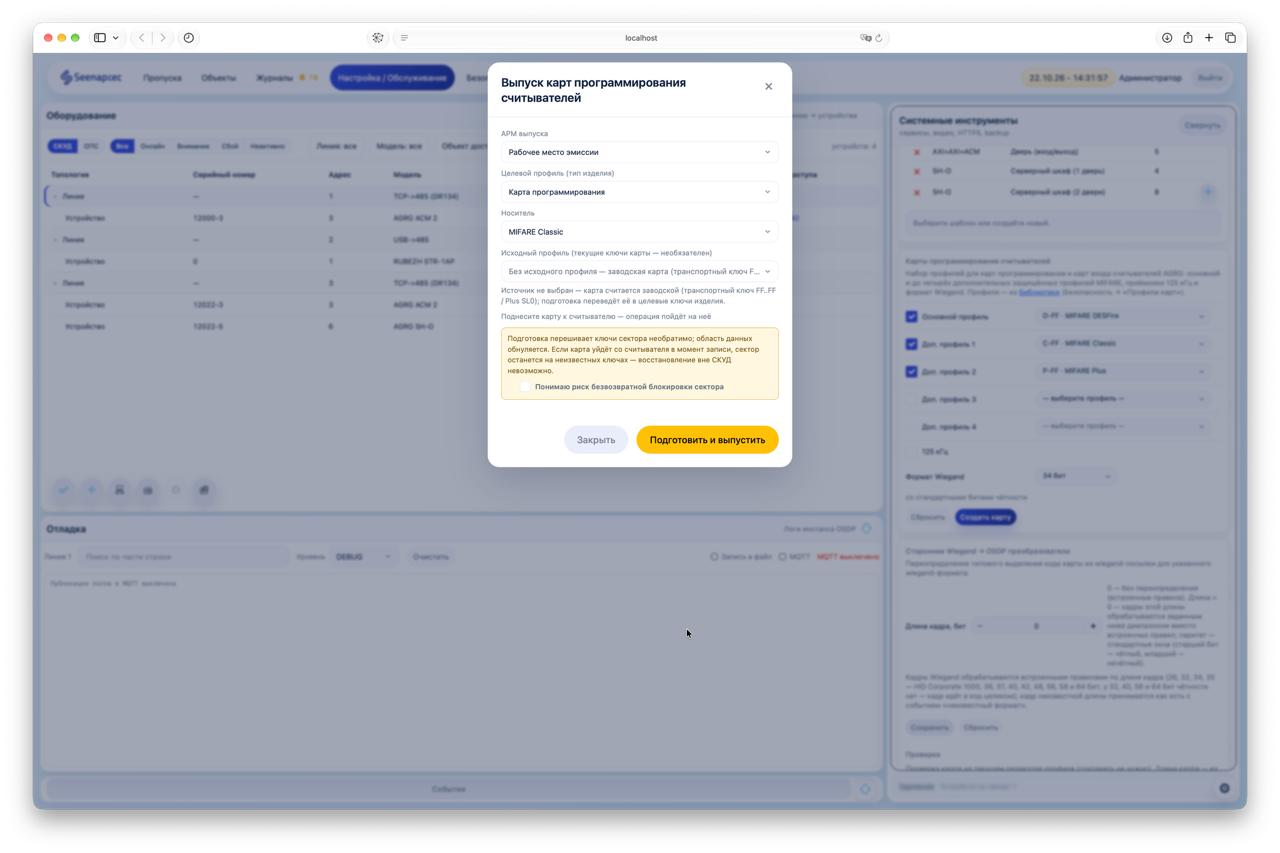
An engineer prepares the required settings in advance and writes them to a special card. The card is then used to program compatible readers directly at the facility.
For example, when equipping a new building
Suppose a company is opening a new multi-story office where 150 readers need to be installed.
Instead of preparing each device individually, an engineer can create a single set of parameters, issue service cards, and use them when configuring the readers.
This approach is especially convenient when replicating identical solutions across multiple sites, replacing equipment, and expanding an existing access control system.
The update also expands support for multiple credential profiles, allowing different card formats to be used within a single reader.
For example, when modernizing an enterprise, previously issued credentials and new secure cards can work side by side, gradually migrating employees to the modern format.
The result is less manual configuration, unified security parameters, and simpler equipment maintenance.
Issuing secure credentials without complex preparation
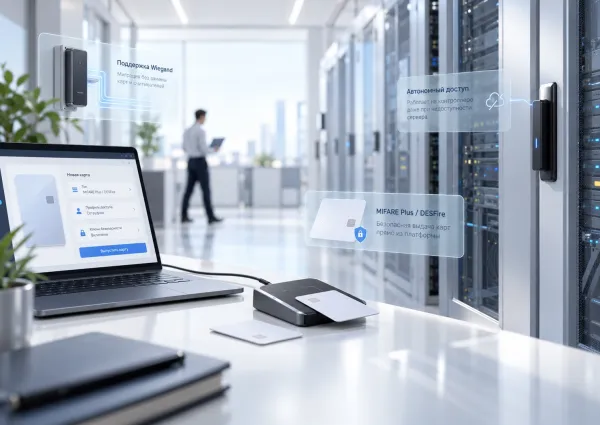
Seenaptec already supports the widely used contactless card families MIFARE Classic, MIFARE Plus, and MIFARE DESFire.
In version 1.7.0, the process of issuing and reissuing them has been reworked. Card preparation and data writing are now performed as a single operation.
Previously, some actions could require separate preliminary preparation of the credential. These steps are now combined in the Seenaptec interface.
What changes for the badge office?
Imagine an enterprise that uses secure access cards for employees and contractors.
When onboarding a new employee, the operator simply selects the required template and issues the pass. The system itself performs the intended sequence of operations on the card.
If a credential needs to be replaced, reissuance is supported, including updating the keys of secure MIFARE DESFire applications.
The key advantage is that cryptographically protected credentials become more convenient in everyday use.
Widespread adoption does not require turning every badge office employee into a contactless card configuration specialist.
At the same time, the option remains to use different credential profiles depending on the requirements of a specific facility.
Mass issuance of passes: dozens of employees in a single operation
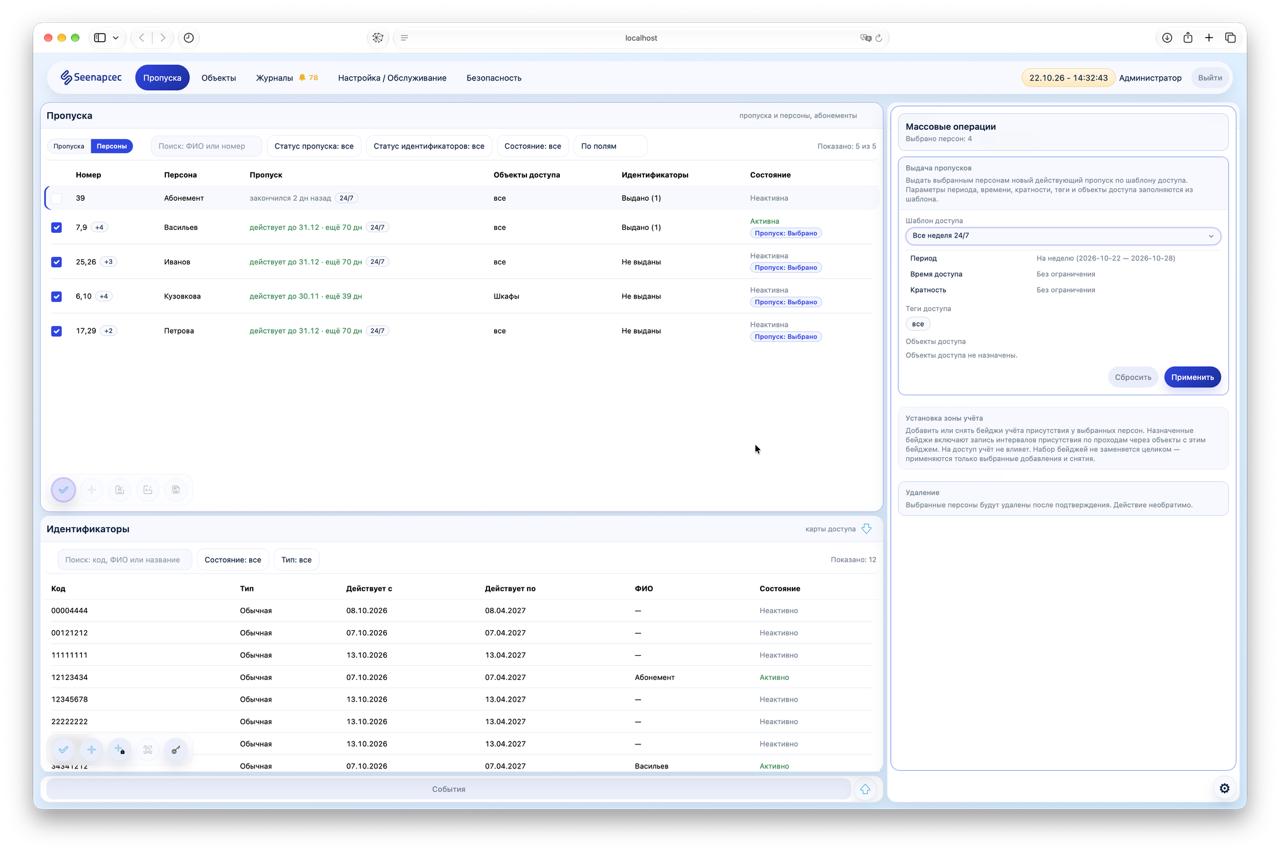
Another new feature is aimed at companies with large numbers of employees, contractors, and visitors.
Seenaptec 1.7.0 implements mass issuance of passes using pre-configured access templates.
Example: a new shift starts at an enterprise
Suppose a manufacturing company hires 80 employees who need an identical set of access rights: the entrance checkpoint, a specific production building, and amenity rooms.
Instead of assigning the same rights to each person one by one, the operator selects the required employees and applies a common template.
Seenaptec processes the issuance and shows the result separately for each person. This makes it possible to immediately see which operations were completed successfully and which require attention.
In addition, creating new persons has been simplified. Employee data entry and pass issuance can now be completed within a single workflow.
These capabilities are especially in demand at industrial enterprises, logistics complexes, business centers, and organizations with regular contractor turnover.
A single platform for domestic and international facilities
Seenaptec 1.7.0 features a full English-language interface.
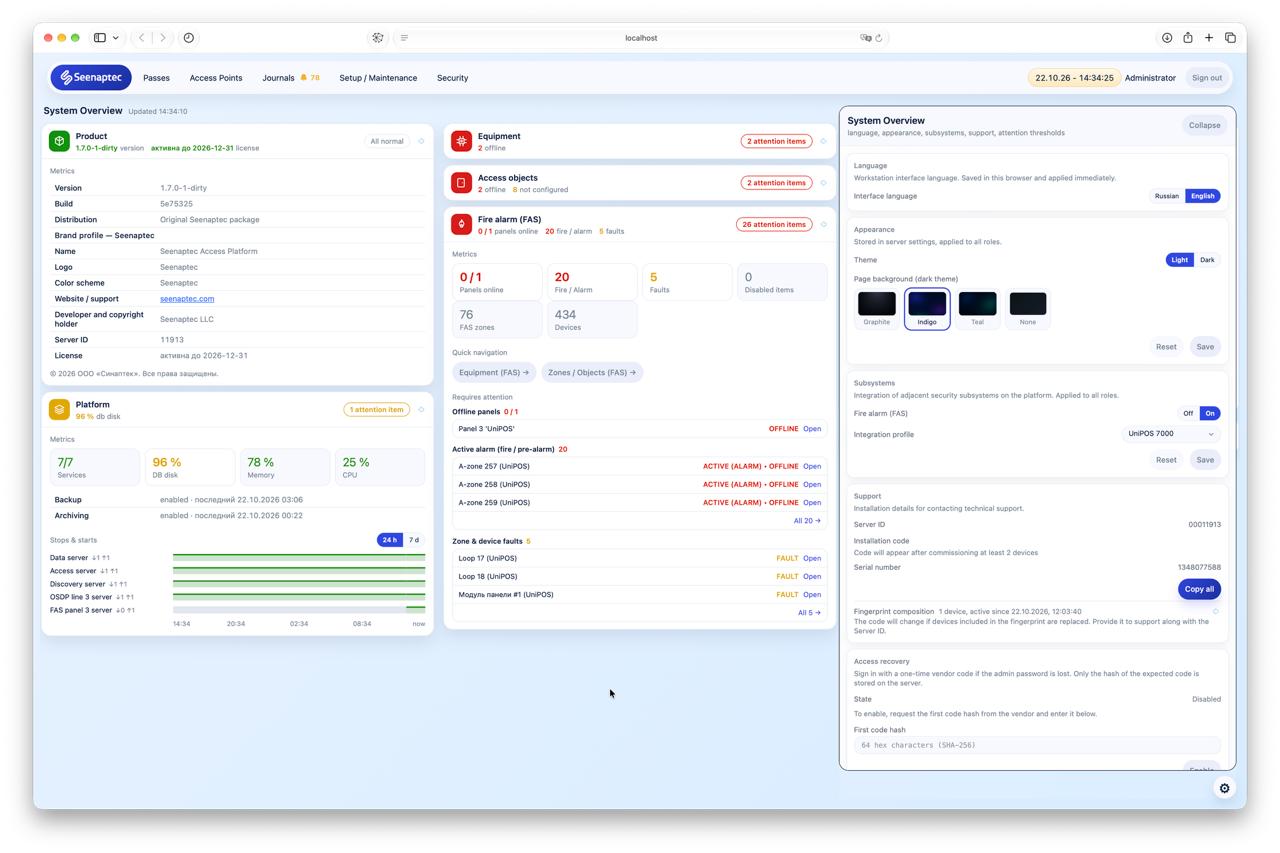
Switching between Russian and English is performed on the fly, without reloading the page.
Not only section names have been translated, but also system messages, log events, and equipment control elements.
Together with the UniPOS integration, this is an important step in developing the platform for the international market.
For example, a company with facilities in different countries can use the same principles for organizing access, configuring equipment, and operator workflows, while providing each department with an interface in the appropriate language.
At the same time, equipment cards, status filters, and navigation have been reworked. Working with large numbers of devices and facilities has become more convenient.
The update package includes administrator guides in Russian and English.
More attention to reliability and equipment maintenance
In addition to new features, version 1.7.0 contains a number of improvements aimed at operational stability.
Diagnostics of the OSDP Secure Channel protected connection have been improved. Now, when equipment connection problems occur, the engineer receives clearer information about the causes of the error.
The reliability of card writing operations has been increased, Wiegand credential processing has been improved, and support for redundant OSDP lines has been refined.
This is especially important for facilities with large numbers of readers, long communication lines, and high requirements for continuous access control system operation.
The package also includes updated firmware version 2.0.4 for AGRG equipment.
What solutions can now be built on Seenaptec?
The development of the platform is gradually changing the approach to physical security design.
While Seenaptec was previously viewed primarily as access control software, its capabilities now extend beyond managing doors, turnstiles, and server cabinets.
Today, the platform already makes it possible to combine several important processes.
For data centers — controlling access to machine rooms and server cabinets, correlating personnel actions with fire alarm events, and building a unified incident history.
For industrial enterprises — organizing centralized pass management, delineating employee permissions, and combining monitoring of access and fire protection equipment.
For business centers and distributed facilities — applying unified approaches to equipment configuration, credential issuance, and security system monitoring.
For system integrators — creating comprehensive solutions on a single software platform, gradually expanding their functionality as new integrations become available.
Going forward, support for the Russian fire alarm systems Bolid and Rubezh will expand the applicability of Seenaptec at domestic facilities where such equipment is already installed.
At the same time, it is important to distinguish between unified monitoring and automatic interaction between engineering systems. The new version combines operator interfaces, events, and management of supported equipment. Automatic interaction scenarios between the fire alarm system and access control actuators must be implemented separately, taking safety requirements into account.
The Seenaptec 1.7.0 update is now available
The new version supports a standard upgrade path while preserving existing data and settings.
When upgrading from Seenaptec 1.6.1, you will need to update the workstation desktop agent, reassign workstations, and install the current firmware for compatible AGRG equipment.
A detailed description of the new features, fire subsystem configuration, reader programming, and administration is available in the user guide.
Seenaptec continues to evolve as a unified physical security software platform that brings together access control, fire alarm systems, equipment, and personnel actions in a common information environment.
Latest news