
Solutions
Modern access control system
A modern access control system is not limited to managing access points. Critical infrastructure facilities must account for contractors, movement routes, server and equipment cabinets, incident investigations, audits, centralized maintenance, and ongoing system development without interrupting operations.
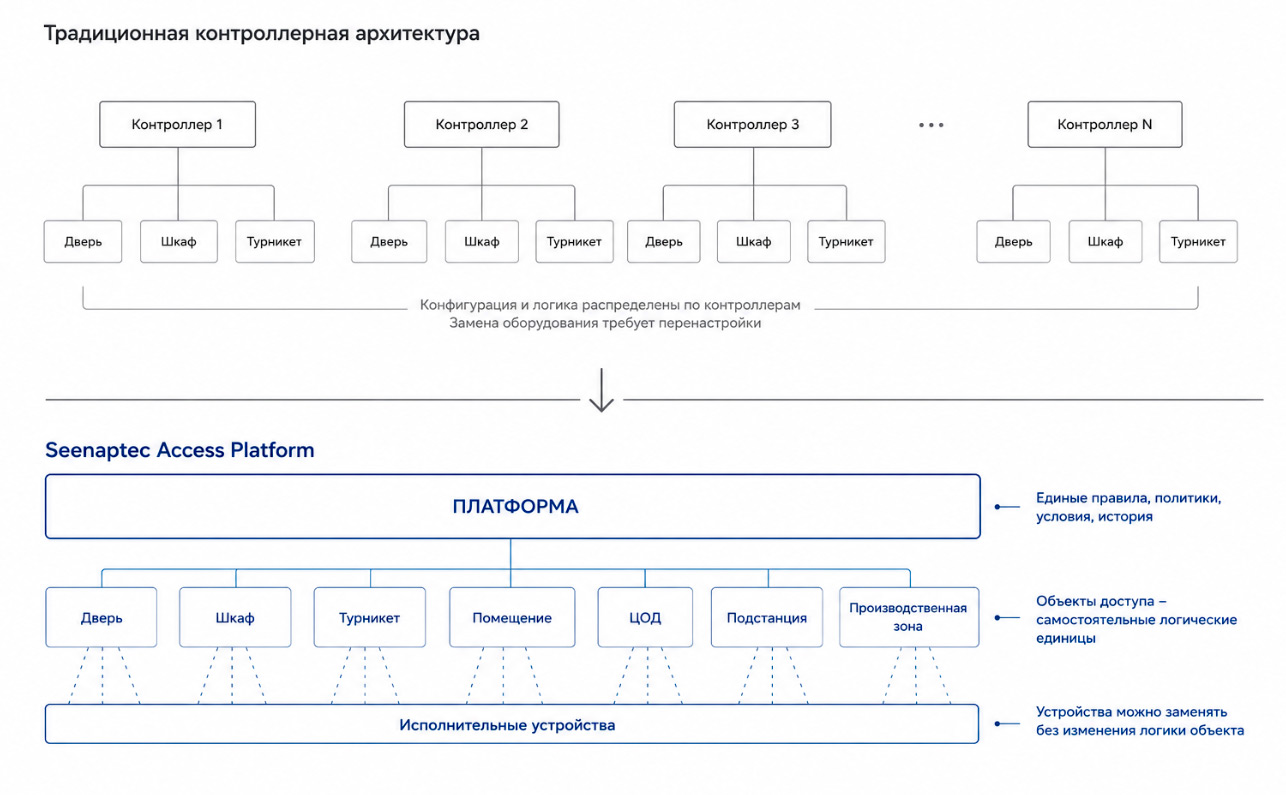
That is why Seenaptec Access Platform is built around protected objects, rather than controllers and their hardware limitations.
A door, turnstile, server cabinet, substation, or production area is treated as an independent access object with its own rules, conditions, event history, and security policies. Devices serve as the platform's actuating components and can be replaced or upgraded without changing the object's logic.
Below is a comparison of the traditional controller-based architecture and Seenaptec as applied to real-world data center, telecommunications, energy, industrial, and transportation use cases. We compare not the number of features, but the approaches to system design, operation, and development.
Partner Program
Transitioning to a new architecture requires additional effort from the design organization and system integrator. Therefore, the Seenaptec Partner Program supports projects involving the modernization of existing access control systems, initial deployments, large-scale facilities, new industry-specific solutions, and integration development by providing special commercial terms and technical support.

Server rooms, machine halls, racks, telecommunication cabinets and engineering zones.

Base stations, communication nodes, outdoor cabinets, and geographically distributed facilities.


Airports, train stations, metro stations, terminals, and high-traffic facilities.