
Seenaptec Access Platform
Software platform for physical access control
Seenaptec Access Platform moves the ACS logic from distributed hardware controllers into a software environment. Peripheral devices read identifiers, monitor inputs, and execute commands, while the server makes the access decision.
This way, the system architecture separates access rules from a specific reader, lock, or controller and lets you manage objects as part of a single physical-infrastructure model.
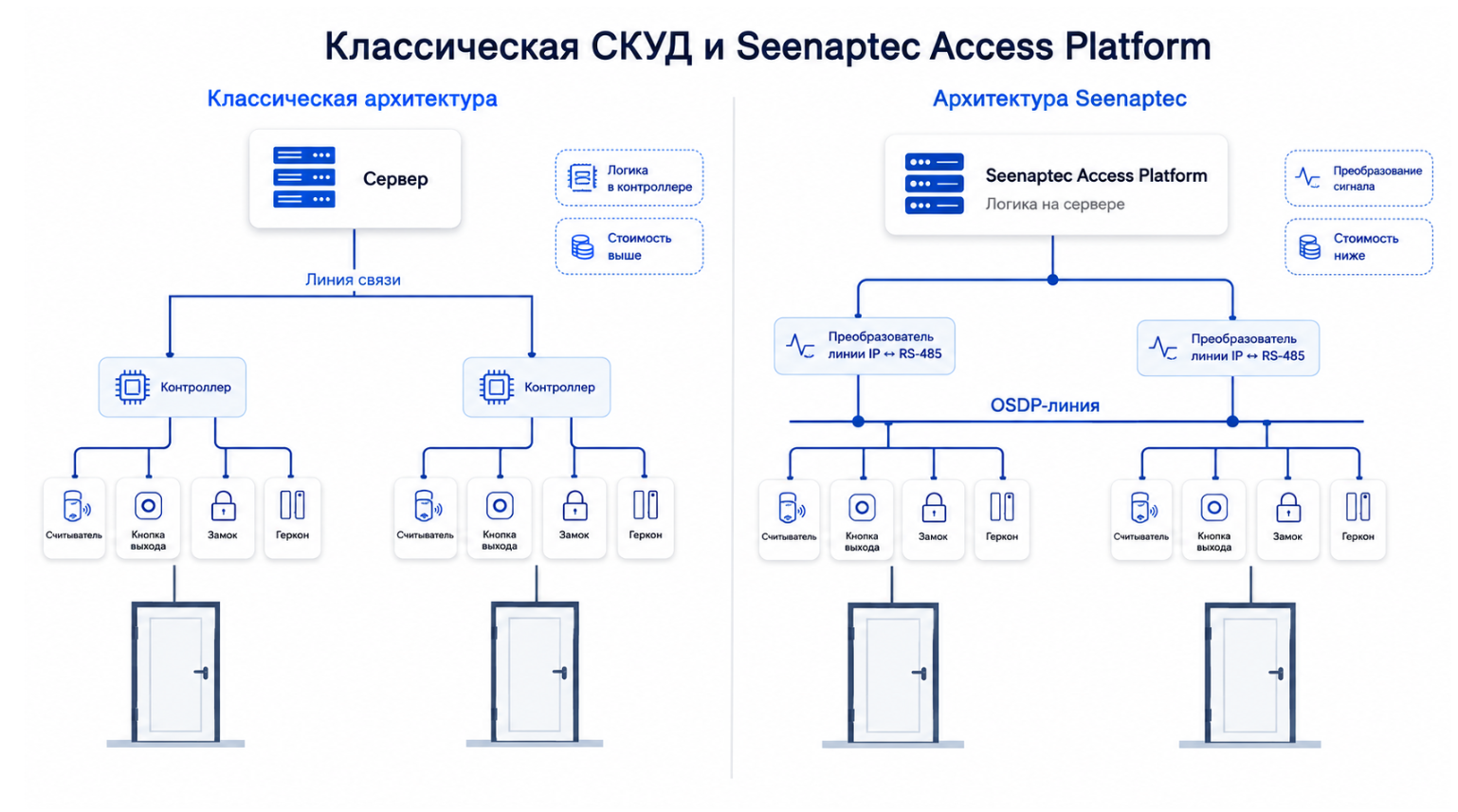
Server instead of distributed logic
The core Seenaptec logic runs on the server. The platform processes access requests, manages object states, communicates with OSDP lines, stores configuration and access data, keeps a log, and provides a web interface and REST API.
Server components are installed on Linux and support amd64 and arm64 architectures. The operator workstation is a standard web browser; no separate client application is required.
The platform architecture eliminates the need to place independent software logic in each hardware controller: equipment becomes the executive part of the overall system, while rules and event processing are centralized on the server.
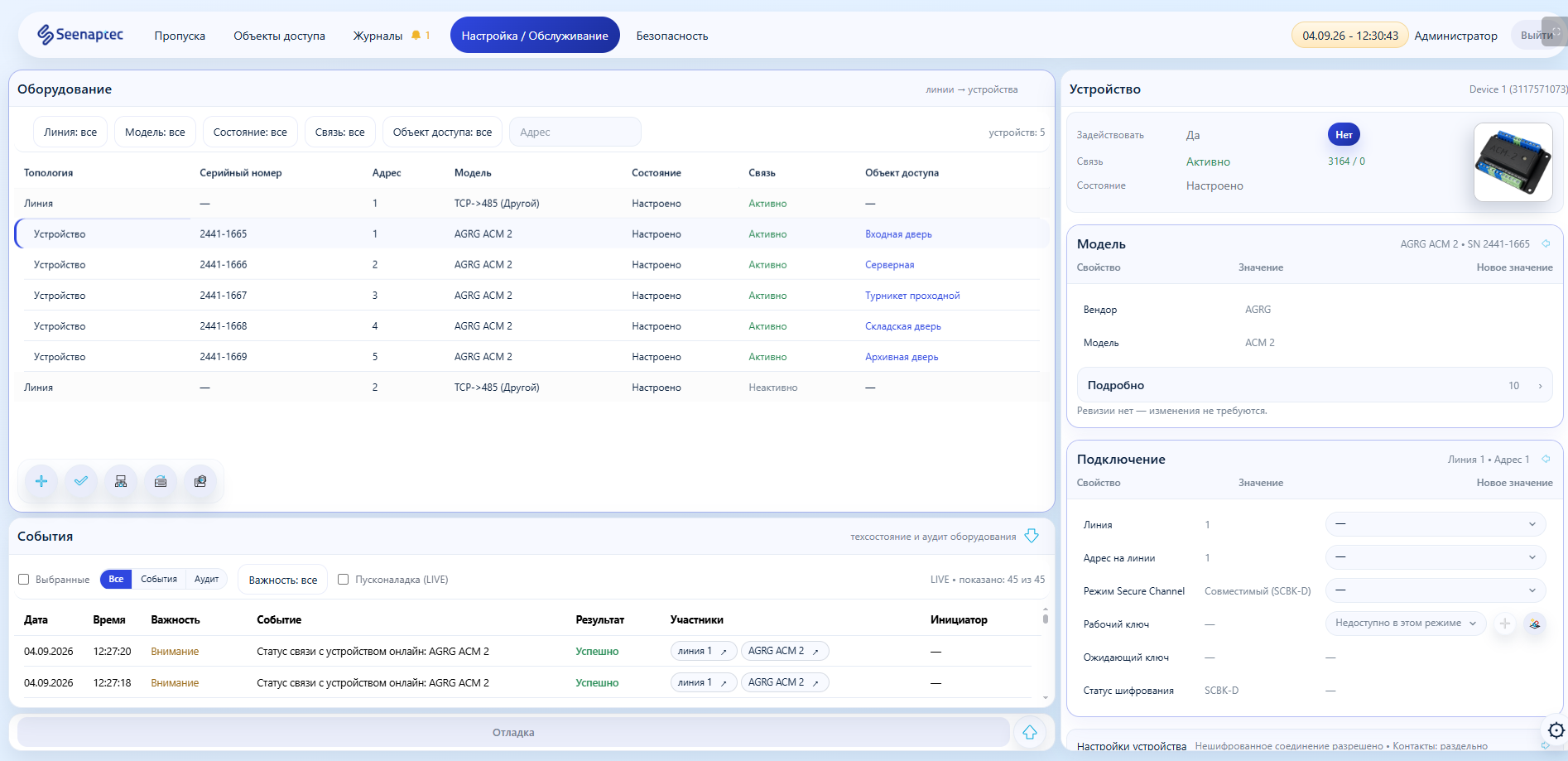
Object instead of controller
The main entity in Seenaptec is the access object.
A door, turnstile, barrier, or server cabinet exists in the system as independent logical objects. Each object is configured with its type, operating mode, access rights, rules, and behavior.
Physical equipment is connected to the object separately. A reader, lock, button, door sensor, or other component occupies the corresponding functional slot of the object.
Rights are assigned to the object, not the controller or reader. Therefore, an object can be created before equipment installation, and a faulty or upgraded device can later be replaced without reassigning rights and without losing the object's history.
This separates two things that are usually tied together in a classic ACS:
- what is protected — the object and its rules;
- how it is implemented — the connected equipment.
Physical space as a system model
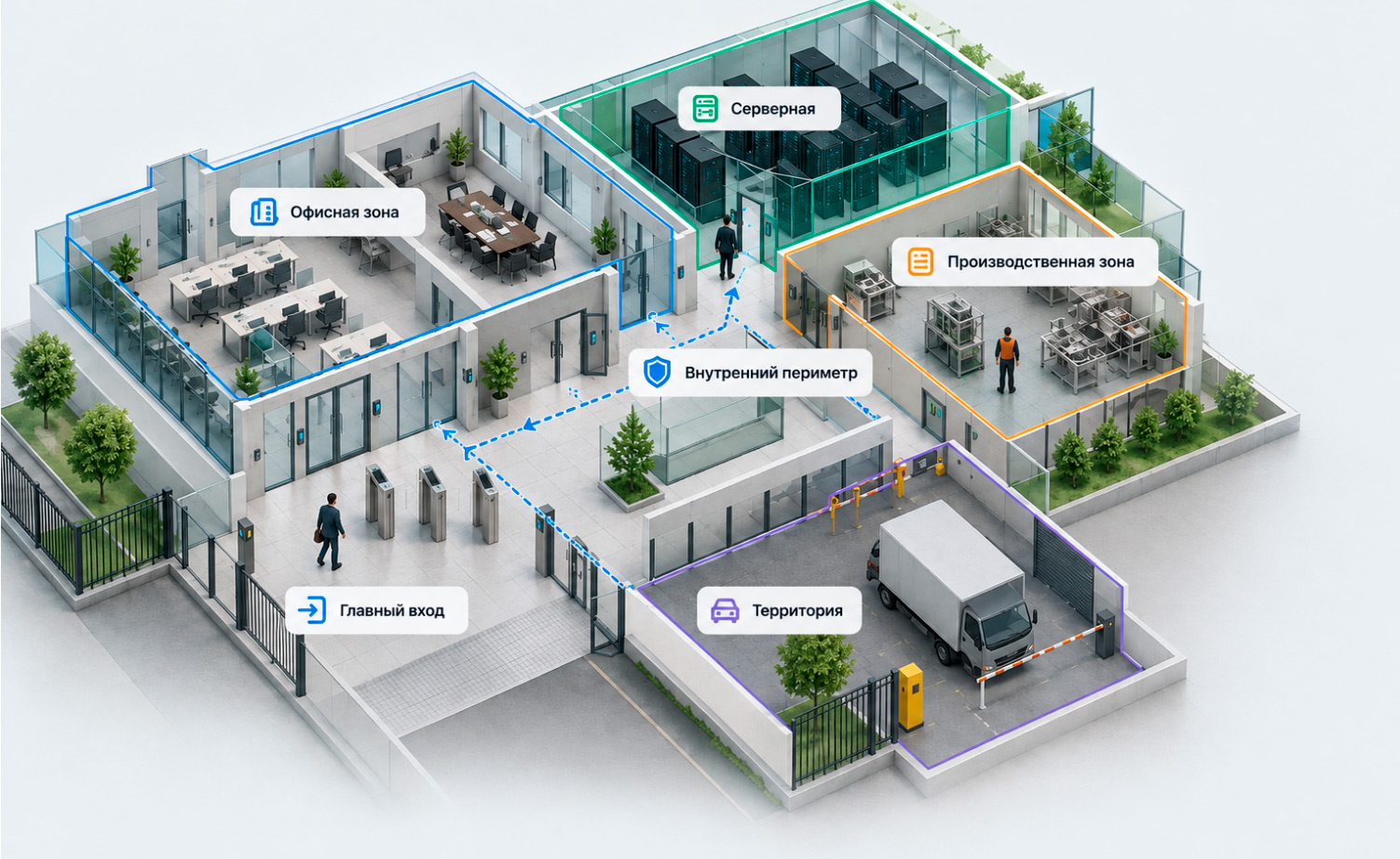
Individual Seenaptec objects can be combined into a common physical-space model.
Doors, turnstiles, cabinets, and other points can belong to perimeters, routes, categories, and presence-accounting zones. A single rule can apply to a group of objects at once, even if they are connected to different equipment lines.
Thus, the system operates not only with an individual event such as “door opened”. It can take into account:
- a person's presence inside a perimeter;
- sequence of movement along a route;
- presence or absence of admission conditions;
- time spent in a zone;
- active sessions working with objects;
- the state of the protected object itself.
Seenaptec tracks, in real time, presence in perimeters, active conditions, and open access sessions.
This makes it possible to describe in a single system not only passageways but also offices, technology zones, rooms, server cabinets, and other physical entities of the enterprise.
Access decision is formed programmatically
Receiving an identifier is only the beginning of request processing.
The platform determines the associated object and passage direction, finds the person and their active credentials, checks access rights to the object, validity period and schedule, credential restrictions, and the object's own rules.
The decision can take into account admission conditions, anti-passback, confirmation requirements, the production calendar, and other rules. After the checks, the server forms a decision and sends the corresponding command to the peripheral device.
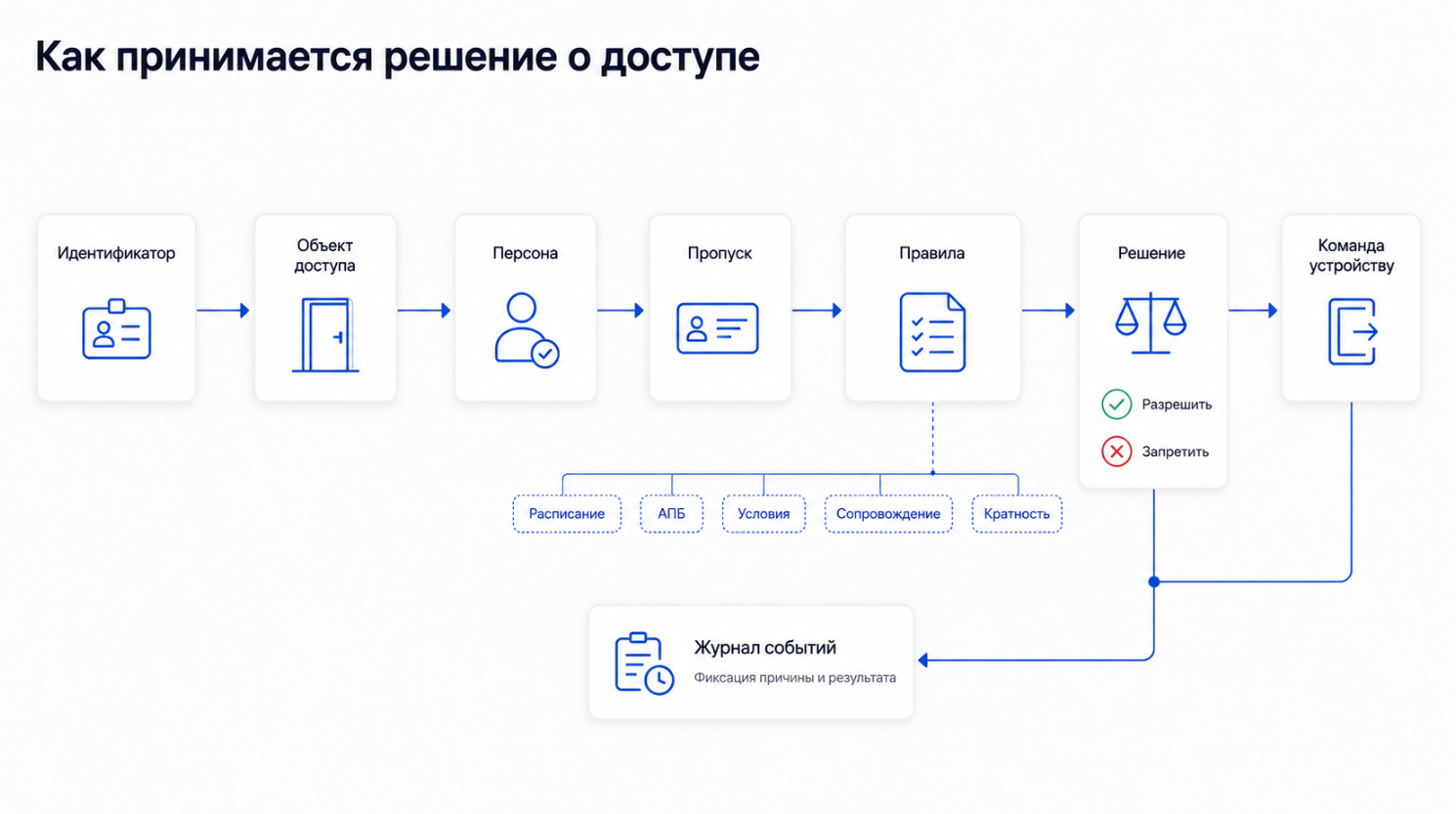
Identifier → object → person → credential → rules → decision → command
The reason for grant or denial, equipment actions, and object state changes are saved to the event log.
OSDP as a single equipment transport
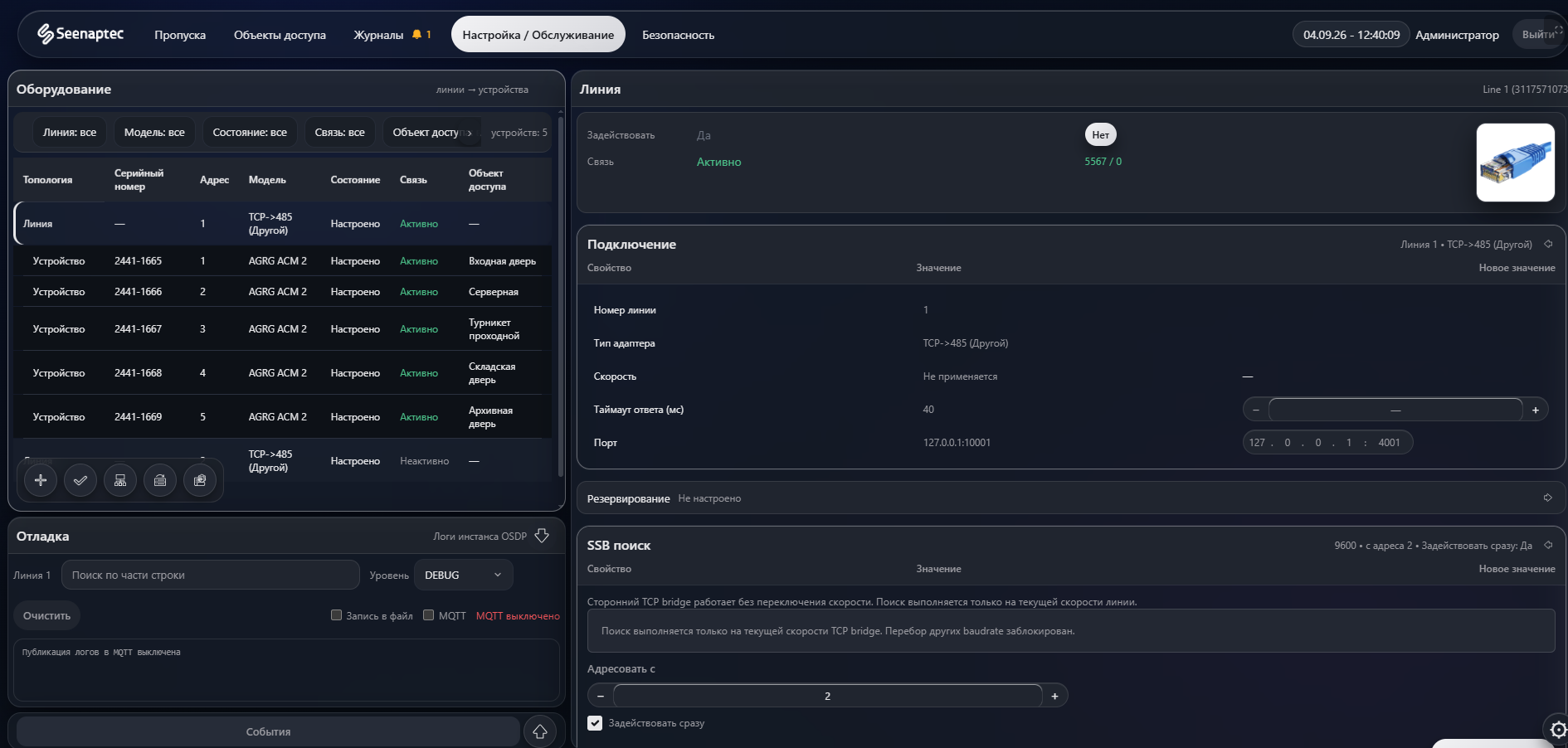
Seenaptec uses OSDP over RS-485 to communicate with peripherals. Lines can be connected to the server via local USB–RS-485 or network Ethernet–RS-485 converters.
Up to 64 addressable devices are supported on a single line. The platform provides line redundancy and centrally monitors their state.
OSDP Secure Channel is supported with working keys and their rotation. Firmware of compatible devices can be updated directly from the platform's web interface.
For equipment that supports Seenaptec SecureBus (SSB), device discovery by serial numbers, address assignment, line speed negotiation, and equipment configuration are additionally automated.
As a result, a single OSDP infrastructure unites readers, locks, handles, inputs, outputs, and other components into a server-managed system.
Unified management environment
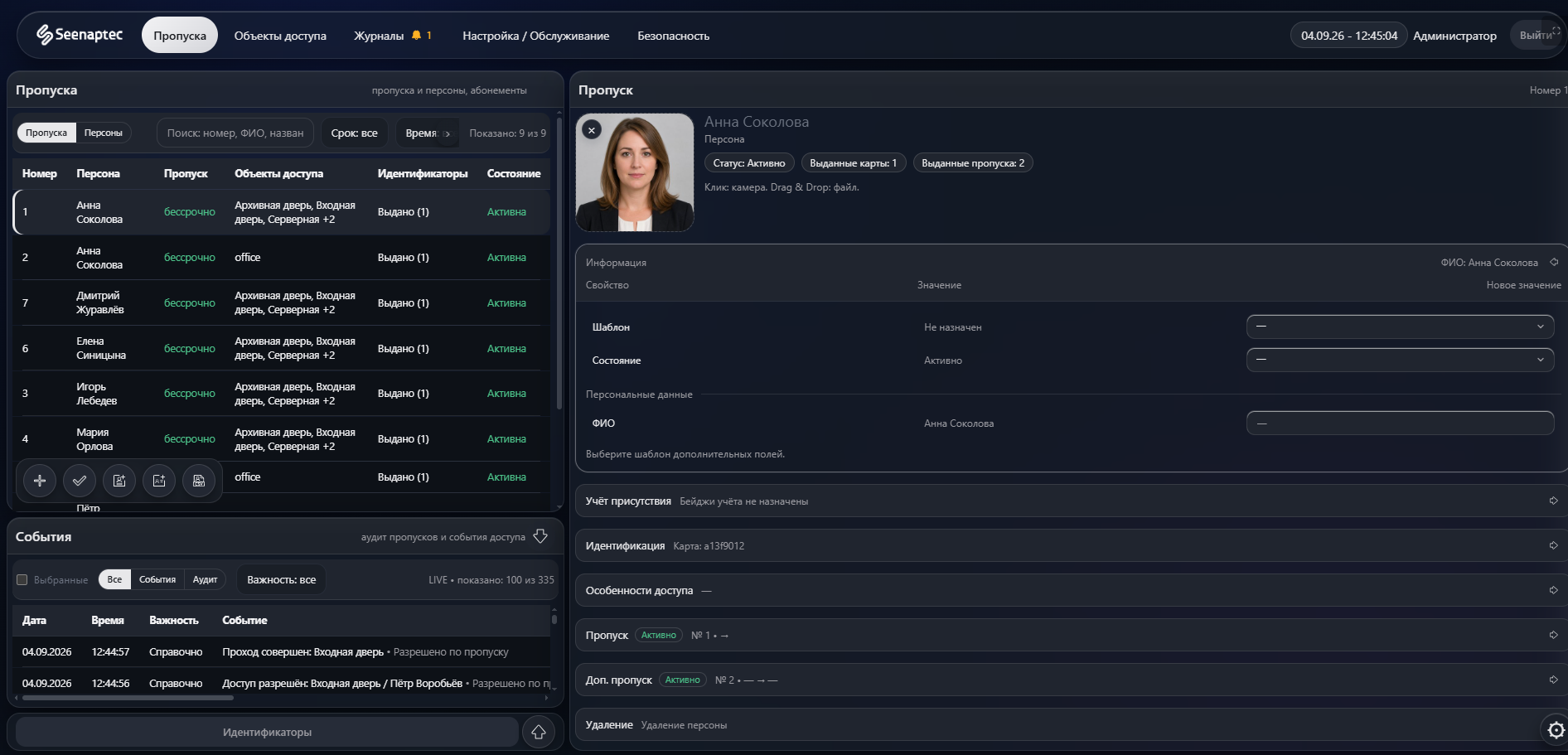
Equipment, access objects, persons, credentials, rules, events, and the current system state are all in one software environment.
Administrators and operators work through the web interface. A REST API with OpenAPI specifications and built-in Swagger UI is provided for external systems.
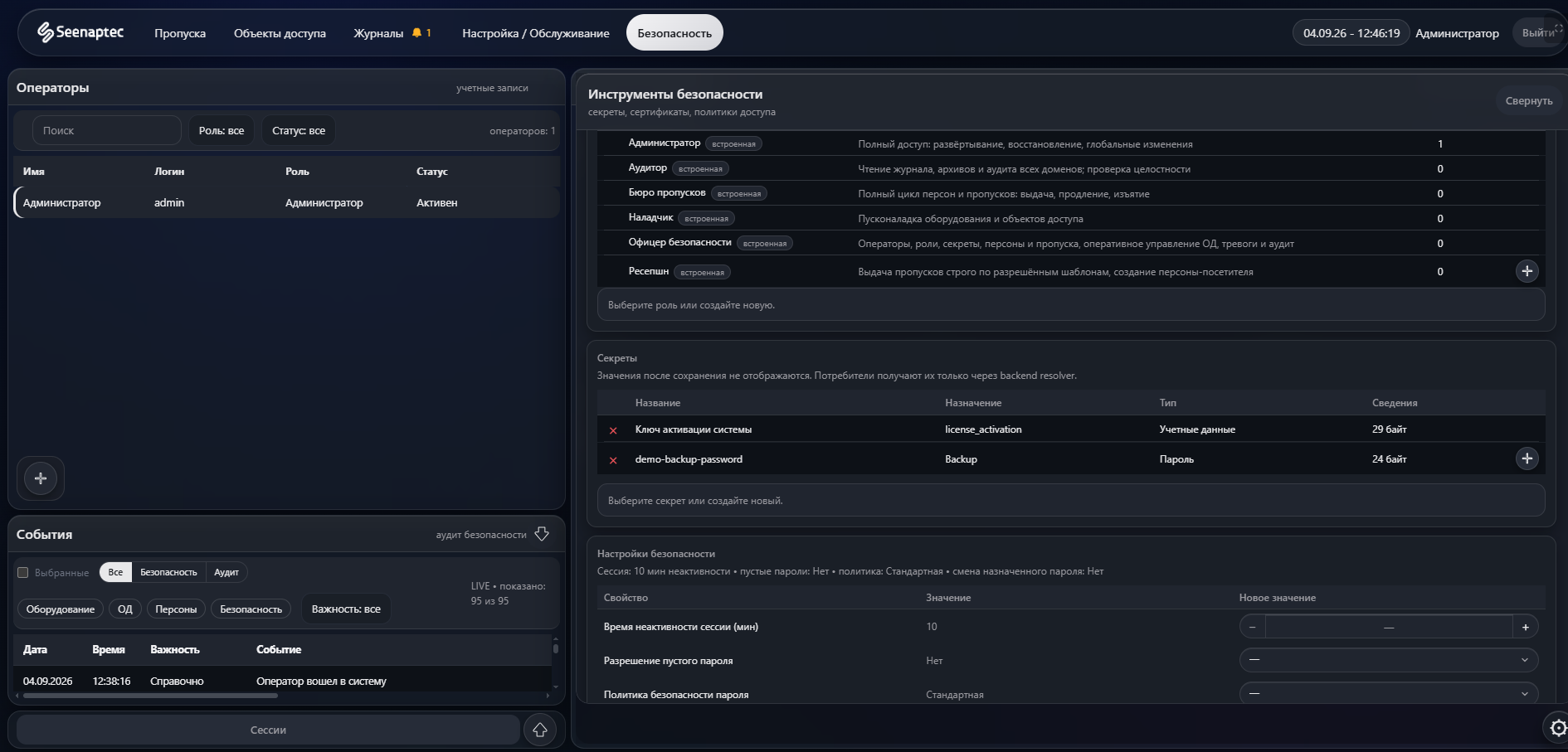
The platform also includes system operation tools: service and equipment monitoring, centralized storage of keys and other secrets, backup, action auditing, and event logging.
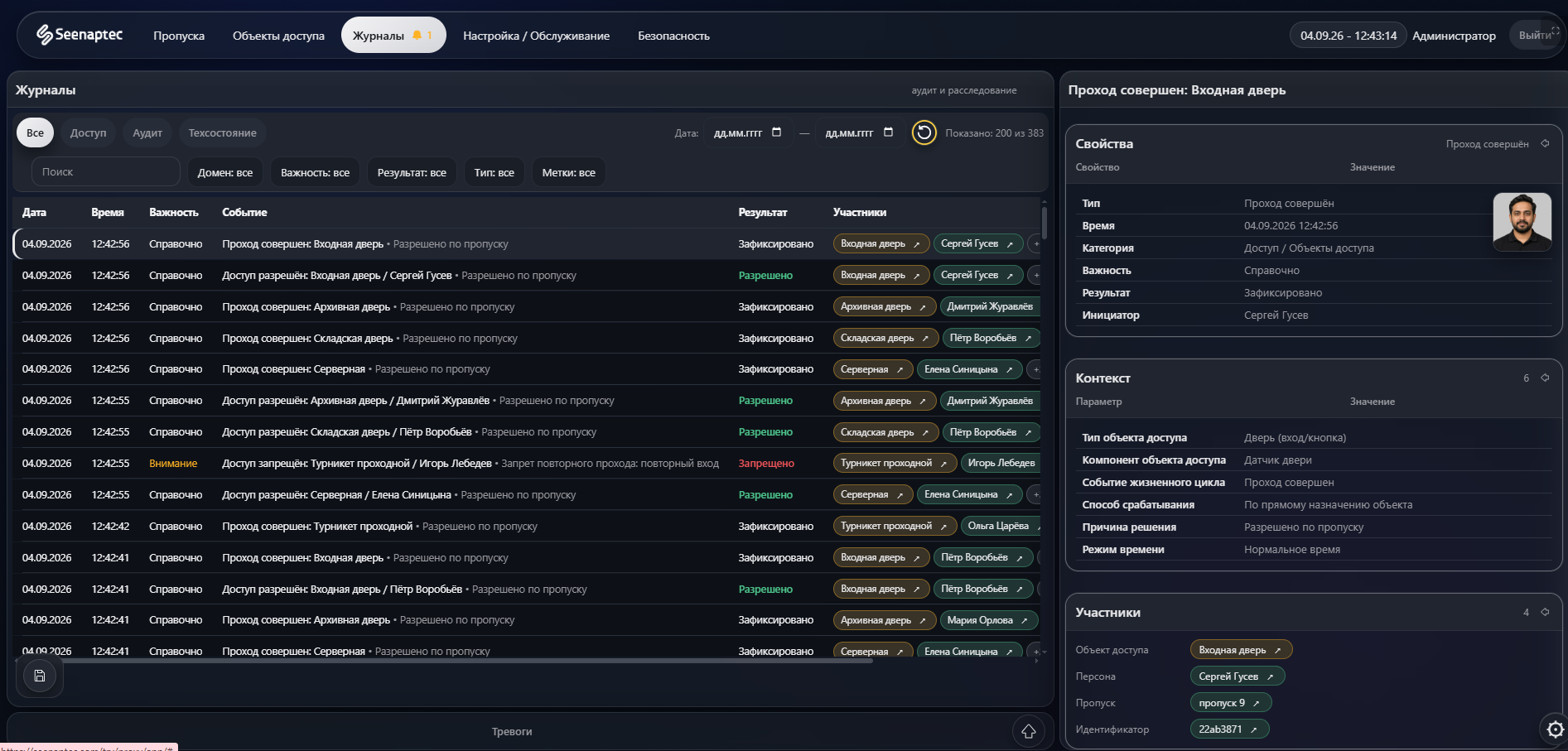
The log is append-only: saved events are not modified by the web interface and are used for subsequent analysis and integrity control of the history.
Platform is extended with modules
Seenaptec Access Platform provides a unified core for managing objects, equipment, access, and events.
Additional software modules extend this model to meet the requirements of a specific site: they add specialized access rules, handling of various personnel types, extended accounting and data storage, special object types, and other functions.