
Modules of the Seenaptec Access Platform
Modular structure
Seenaptec is built as a set of functional modules running on top of a unified object model. They are responsible for access control, hardware, operation, integration, data storage, and specialized scenarios.
The set of available modules depends on the edition and license of the platform.
Virtual Controller
A server module that runs the access control logic. It processes requests from OSDP hardware, determines the associated access object, checks rights and rules, and generates a command for the actuator.
Unlike the classic ACS architecture, the decision is made by software on the server rather than distributed among hardware controllers. This makes it possible to build unified logic for objects located on different lines and physical nodes.
Web Interface
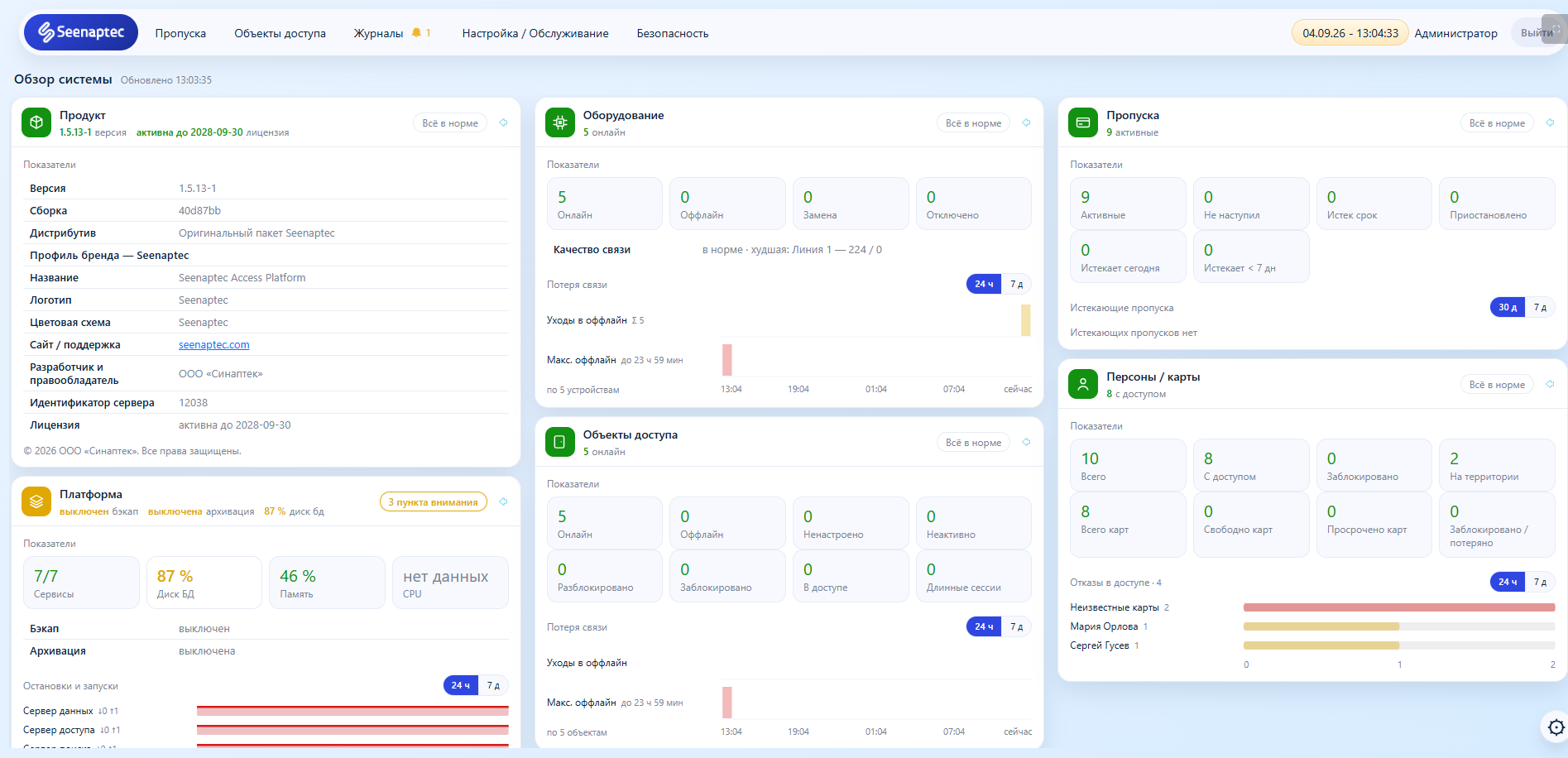
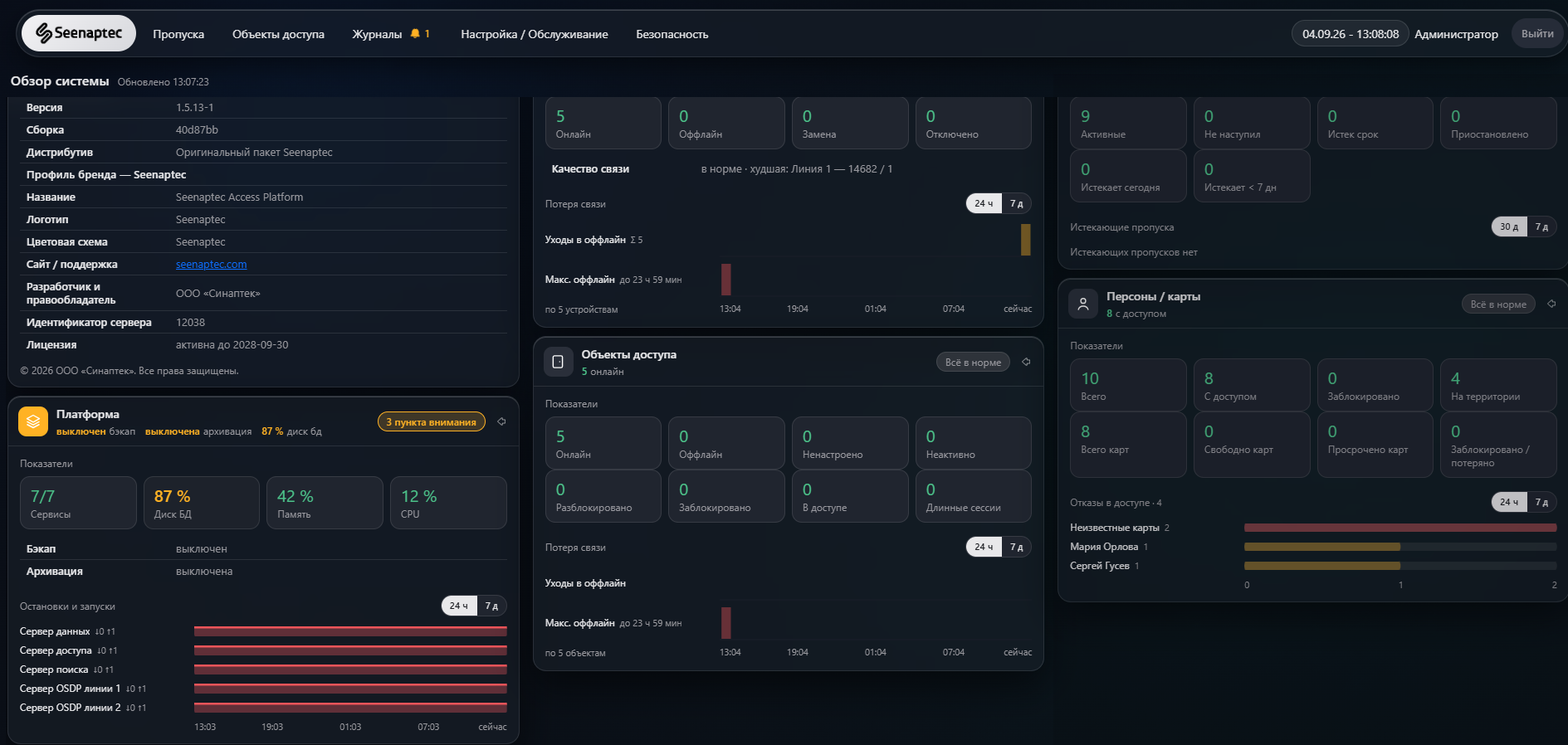
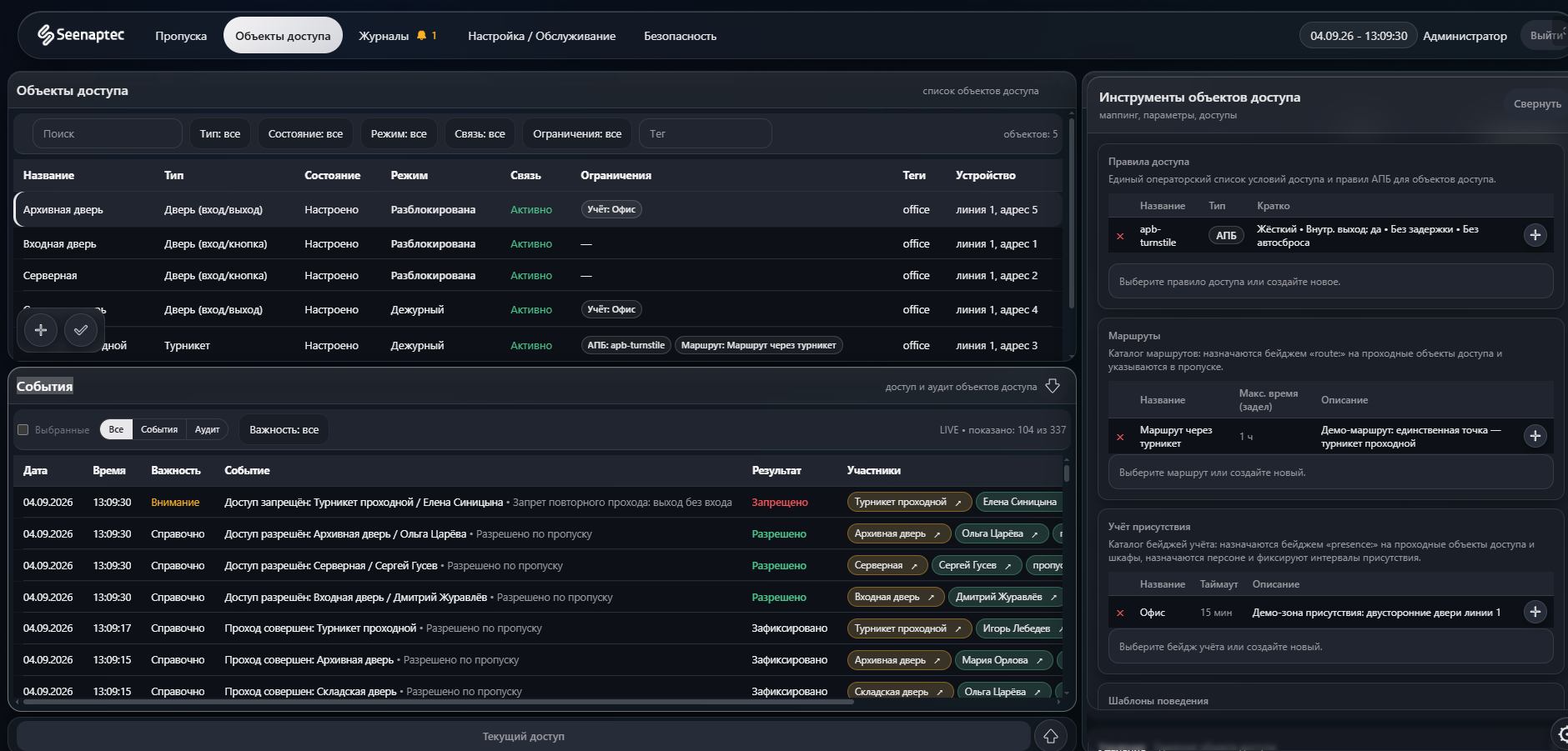
The main workplace for the Seenaptec administrator, engineer, and operator. The interface runs in a browser and does not require a separate client application to be installed.
It is used to configure hardware, create access objects, work with persons and passes, view the current state, events, alarms, and system parameters.
REST API / OpenAPI
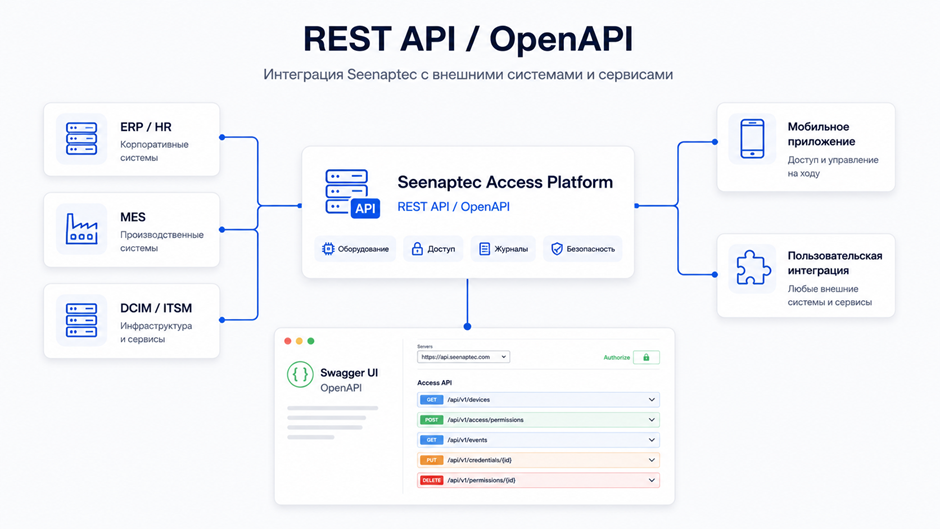
A software interface for integrating Seenaptec with external systems. Through the REST API, hardware, access data, logs, and security functions are available; the API documentation is provided in OpenAPI format and is accessible through the built-in Swagger UI.
It is used for integration with enterprise systems, customer applications, and external automation services.
Hardware Firmware Management
A module for centralized firmware updates of OSDP devices (AGRG partner) directly from Seenaptec.
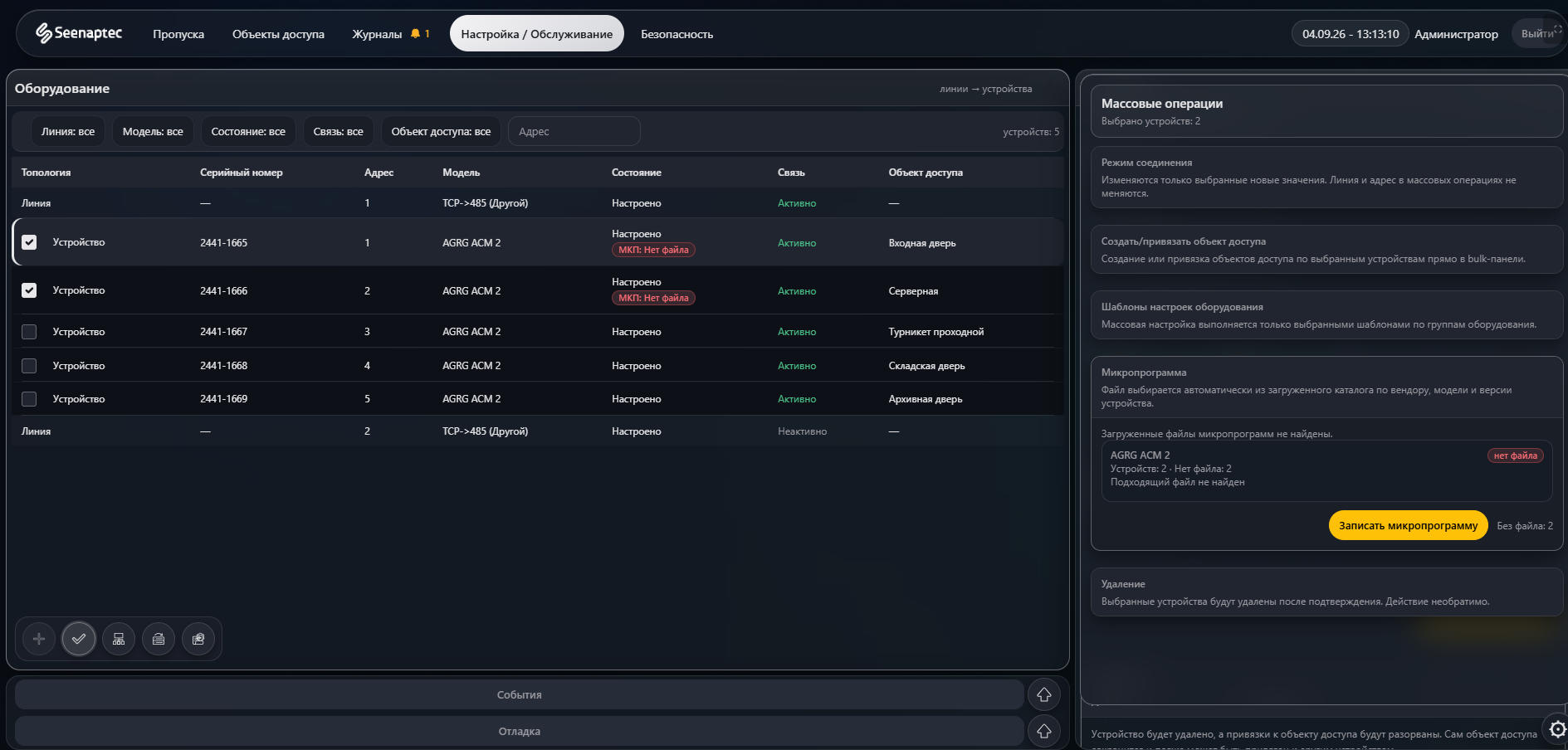
It supports individual and bulk firmware writing. For compatible hardware, the system checks that the file matches the device and verifies the result after the update.
Secrets Vault
Centralized secure storage of passwords, OSDP keys, card keys, and HTTPS certificates.
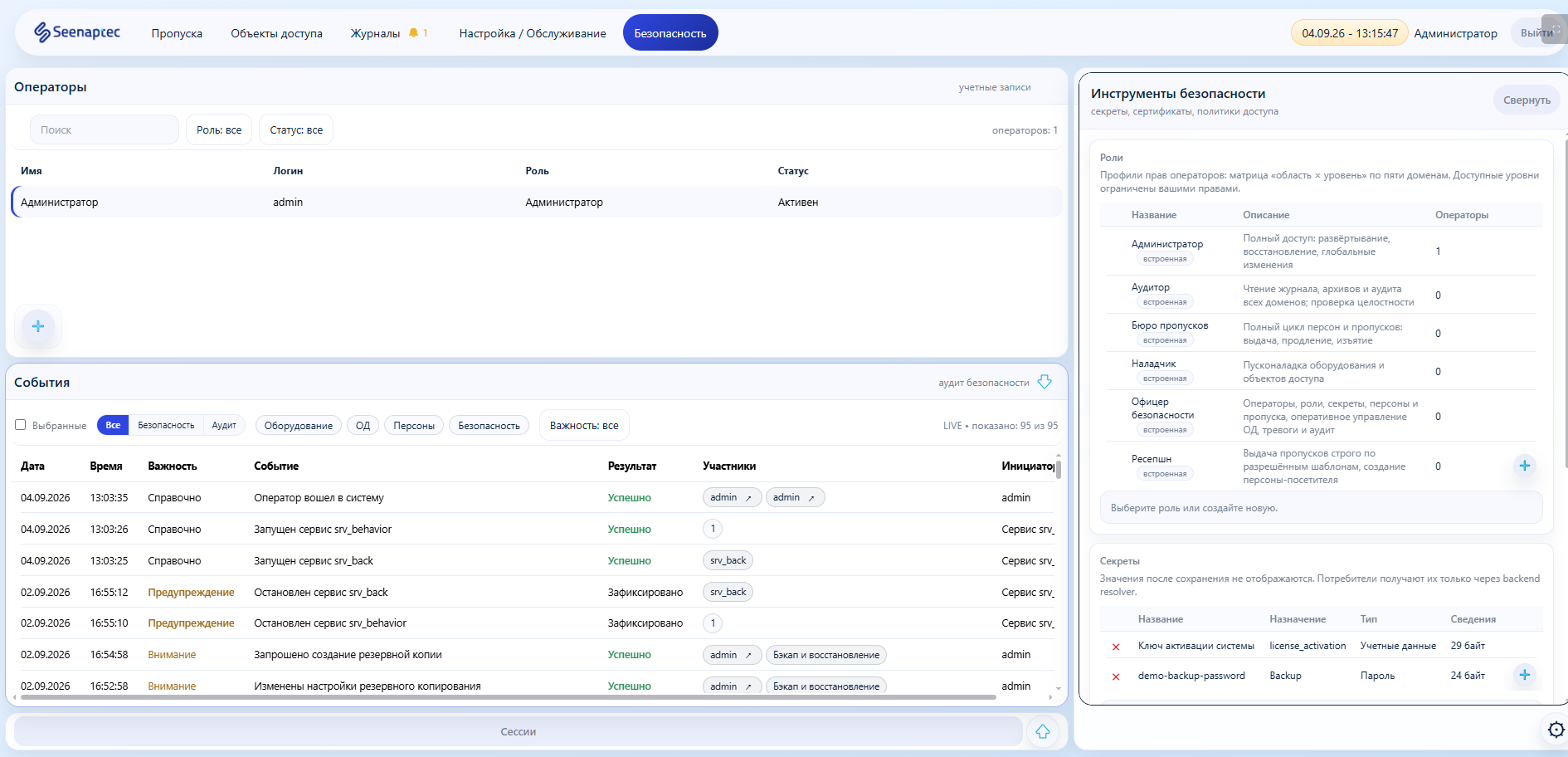
A secret is entered into the system when created or replaced, after which its value is no longer displayed in the interface.
Hardware Templates
A module for creating typical hardware configurations and schemes for binding them to access objects.
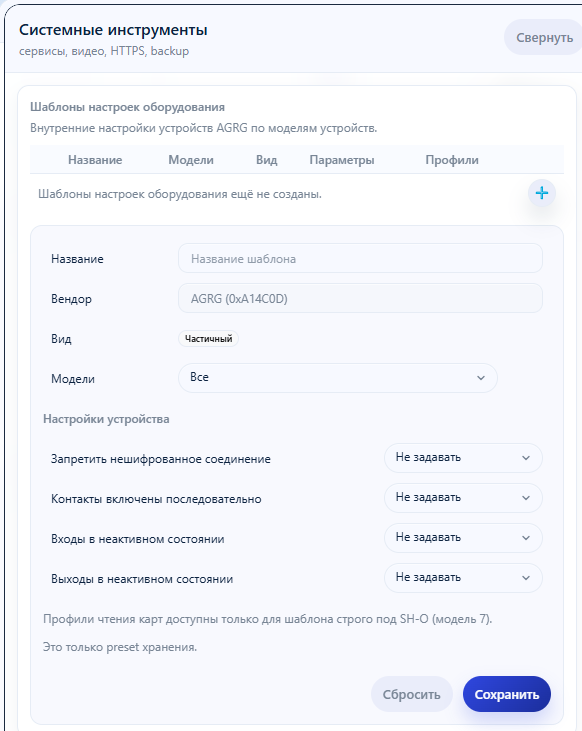
Templates allow you to describe a standard configuration for a door, cabinet, or other object once and then apply it when putting large amounts of hardware into operation. This is especially important for objects with dozens or hundreds of identical points.
Bulk Configuration
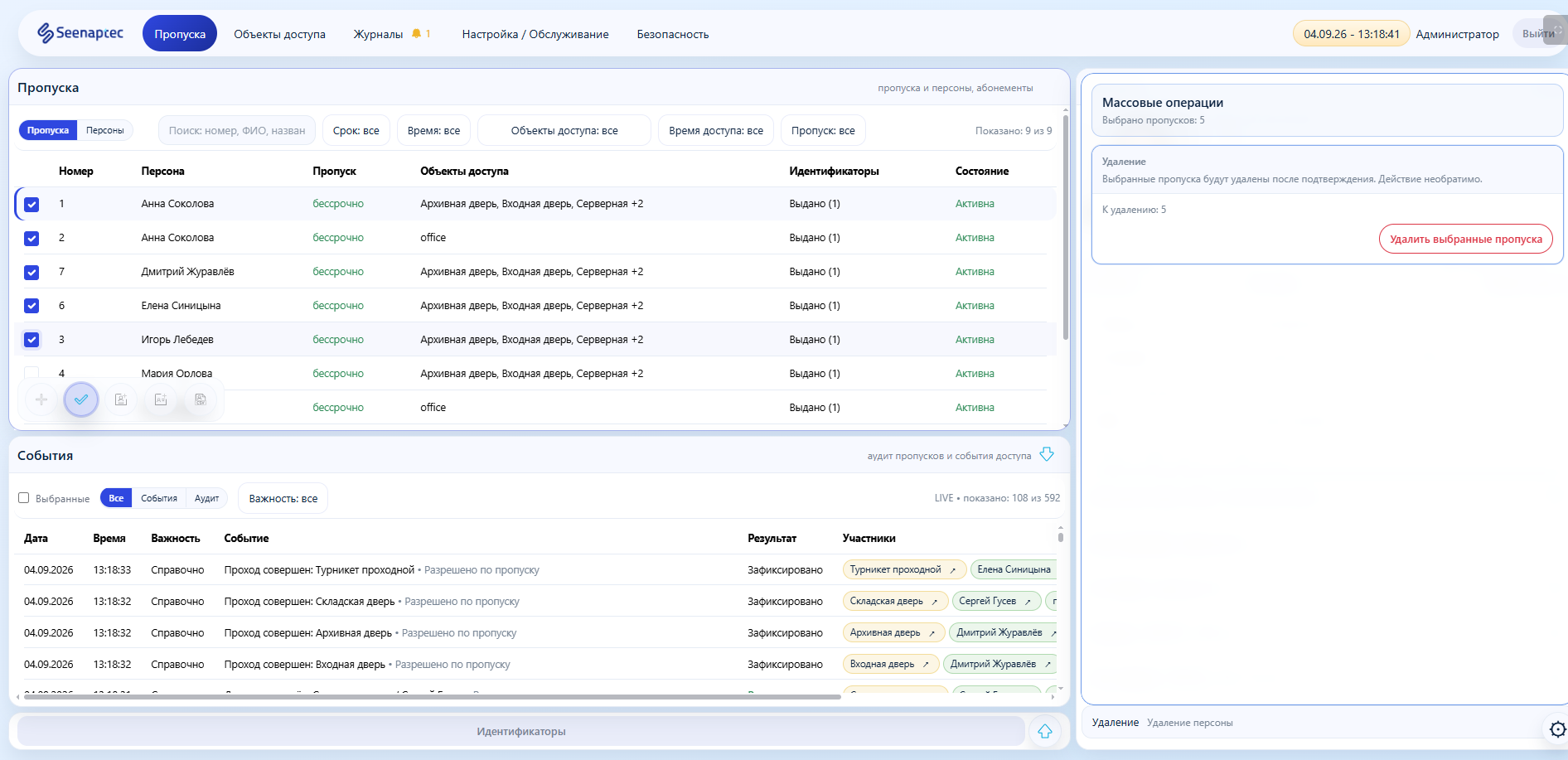
Group operations on hardware and Seenaptec objects.
It allows you to apply settings simultaneously, perform operations on a group of devices, create and bind objects by templates instead of manually configuring each point sequentially.
OSDP Secure Channel
A module for centralized management of secure exchange with OSDP hardware.
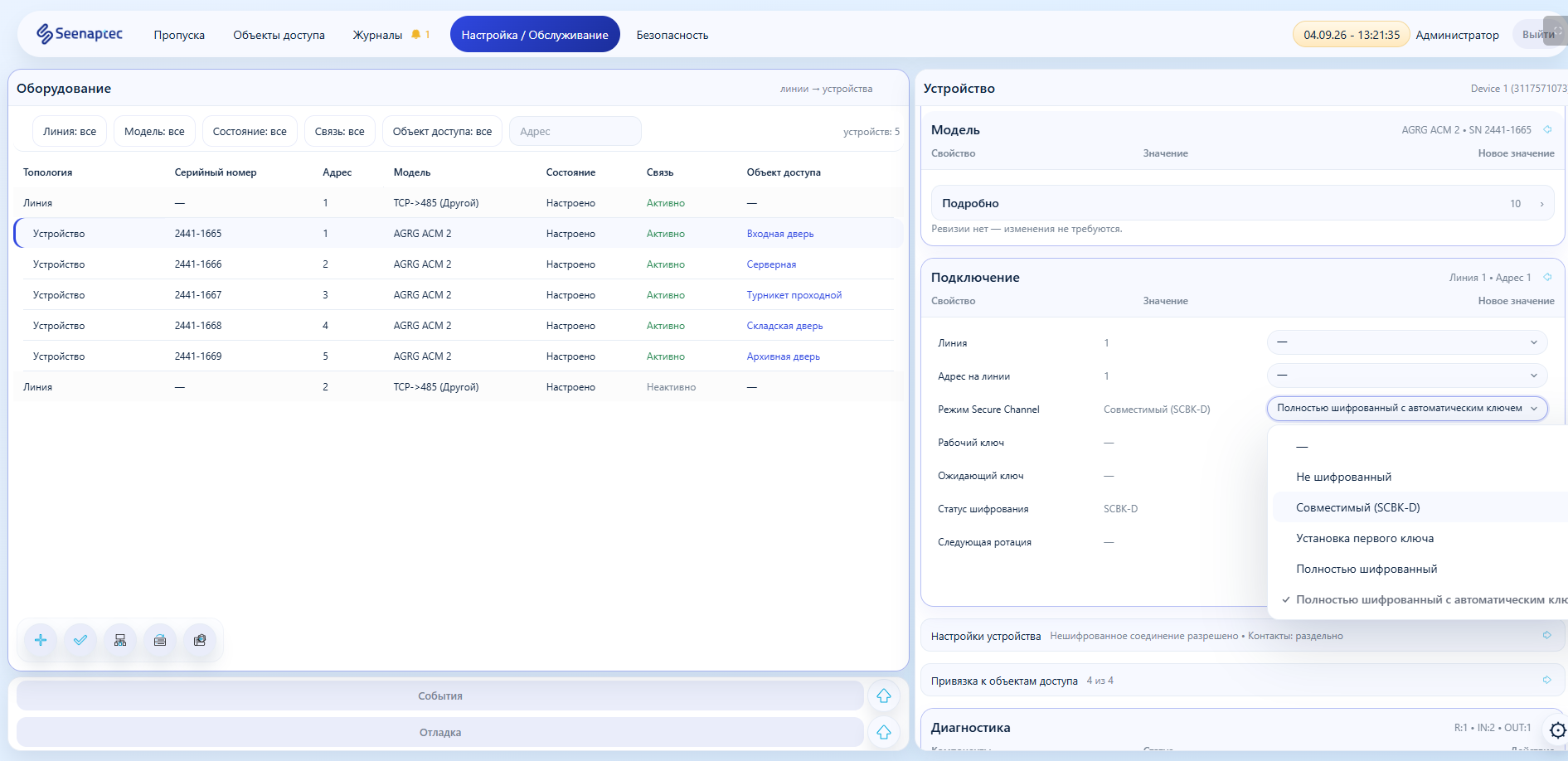
Seenaptec allows devices to be switched to Secure Channel, operational keys to be set, and their group configuration and rotation to be performed. Everything is stored in the platform's secure vault.
Automated Hardware Discovery
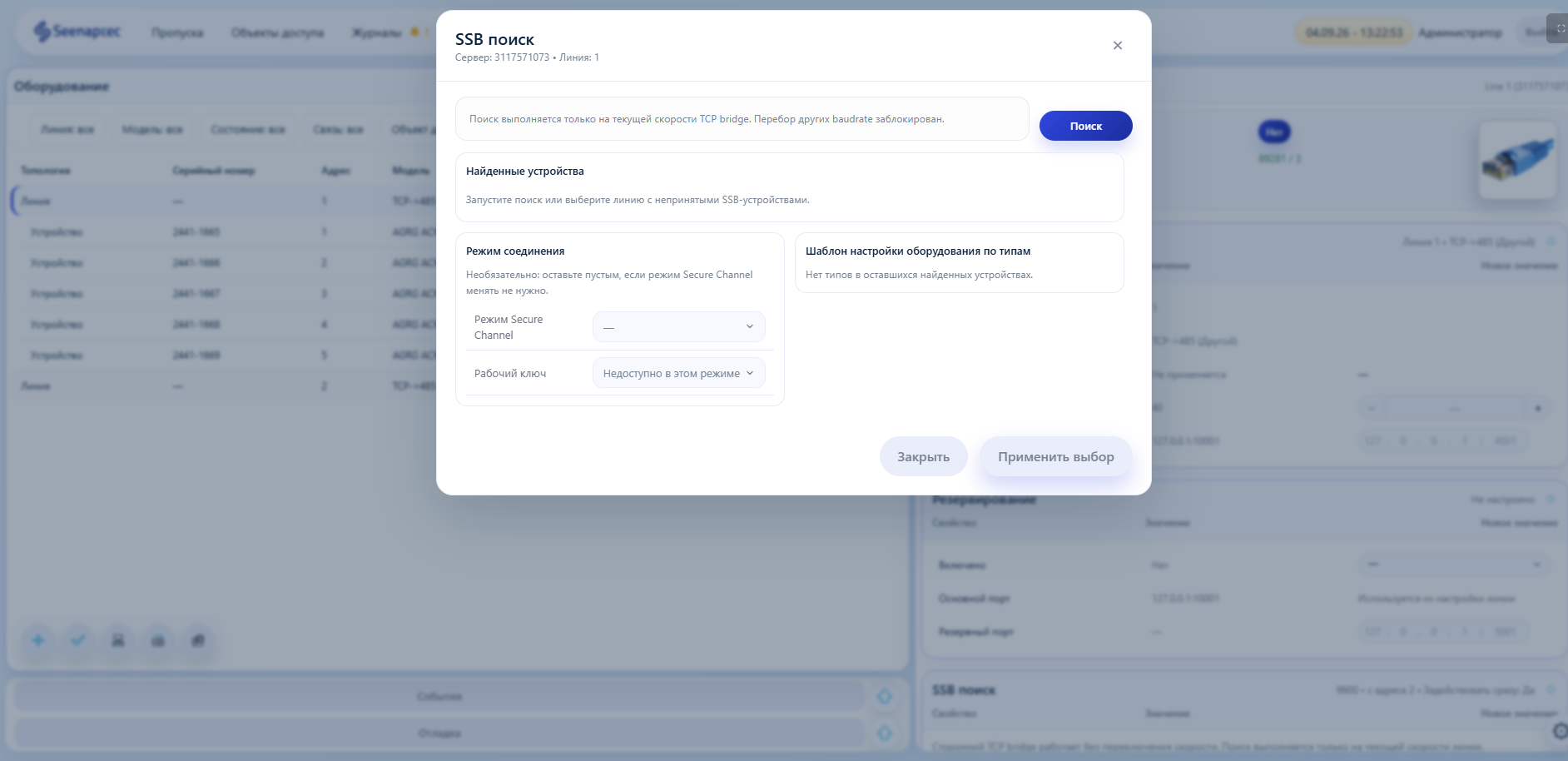
A module for discovering and commissioning OSDP devices.
For hardware supporting Seenaptec SecureBus, the system can discover devices by serial numbers, assign addresses, and negotiate line parameters. The hardware can then be bound to access objects in groups using pre-prepared templates. In the price list, this functionality is separately listed as automated discovery and binding of hardware.
Antipassback
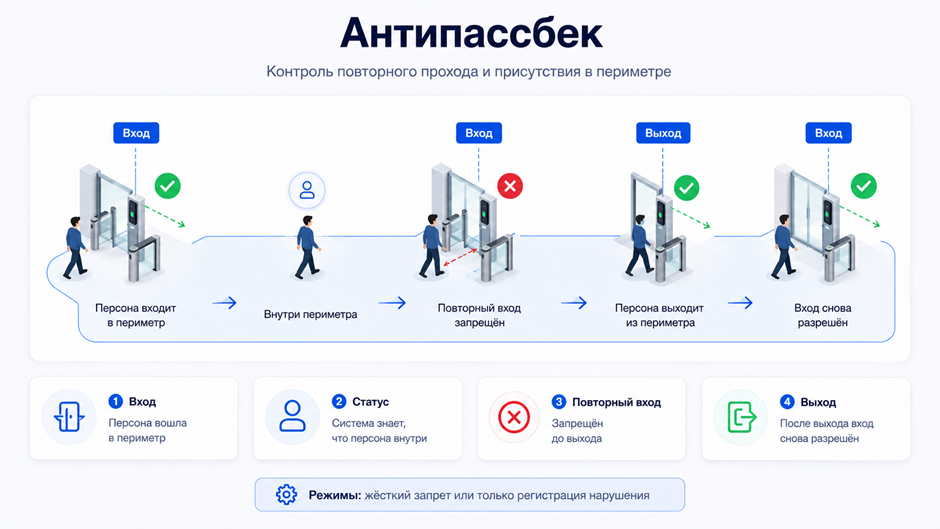
A module for controlling re-entry and presence inside a secured perimeter.
Seenaptec objects form a logical perimeter with entrances and exits. The system maintains a person's presence state and can either prohibit incorrect re-entry or allow it while logging a violation.
Event Log and Audit
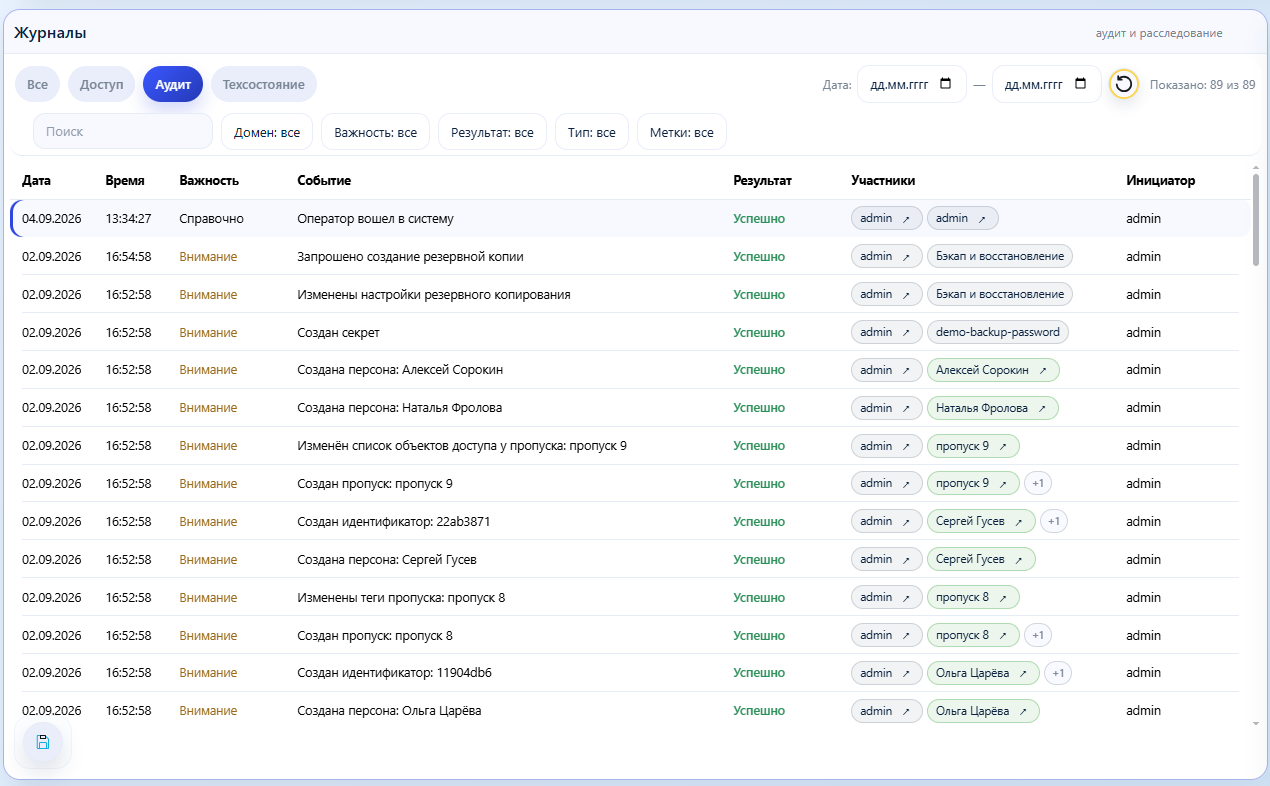
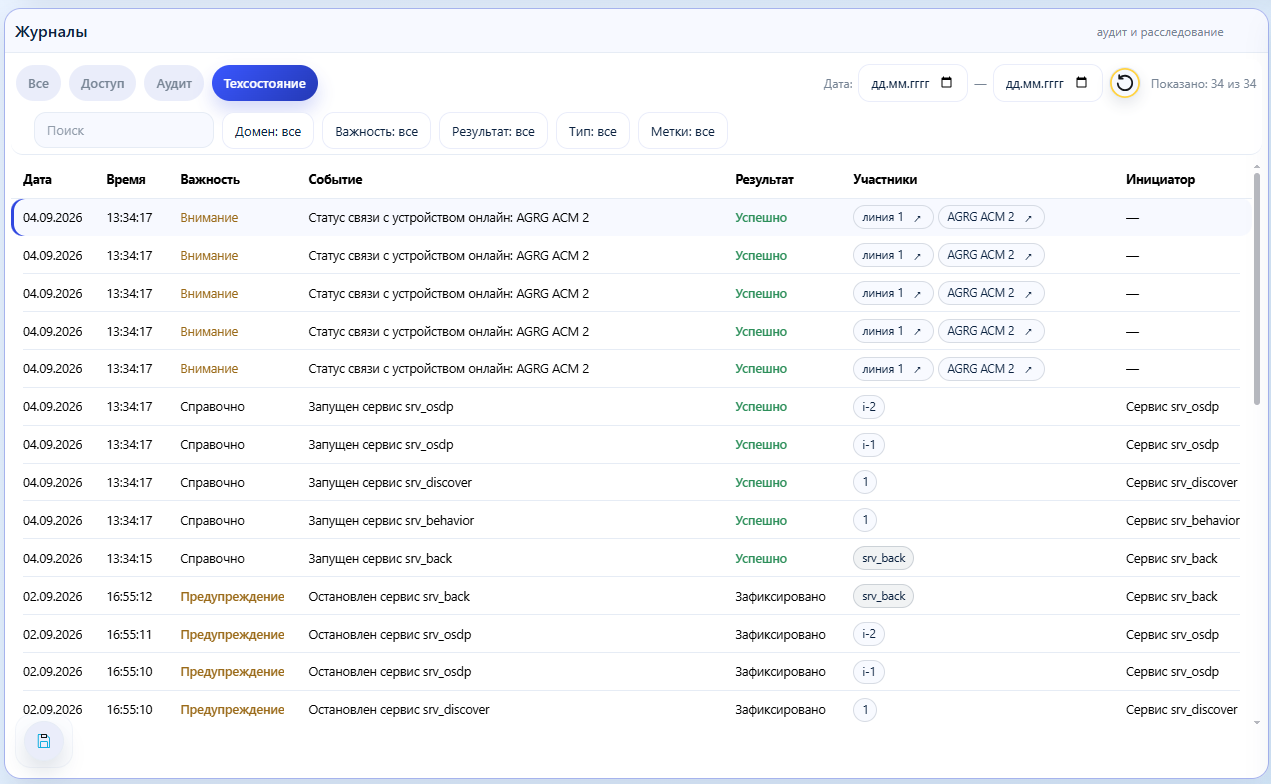
A unified log of access events, hardware technical state, and operator actions.
Seenaptec stores not only the fact of an event, but also the reasons for decisions and parameter changes "before / after". Log records are linked in a hash chain, making it possible to detect modification, insertion, or deletion of historical events.
Persons, Identifiers, and Passes
The main module for managing access subjects.
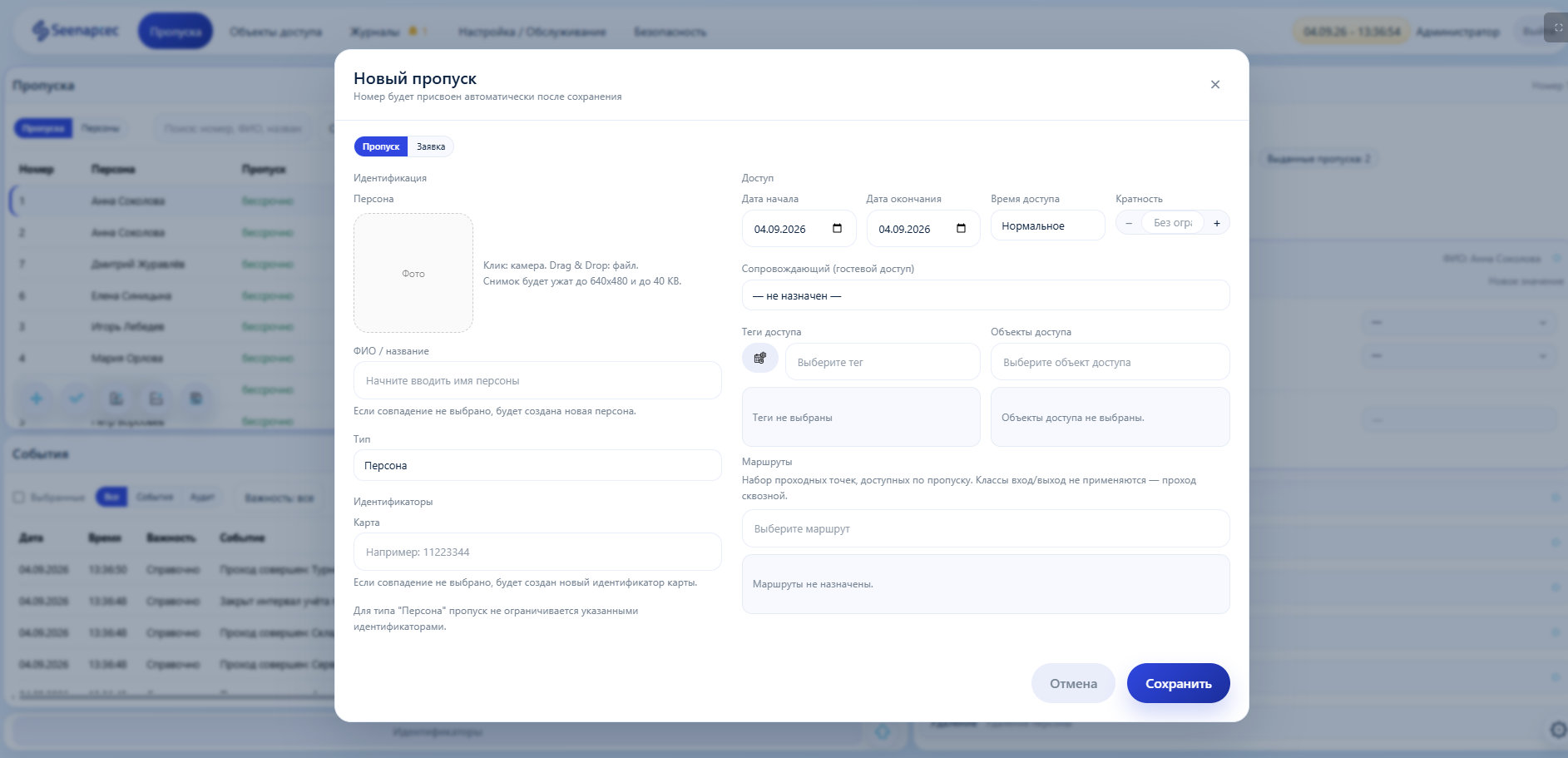
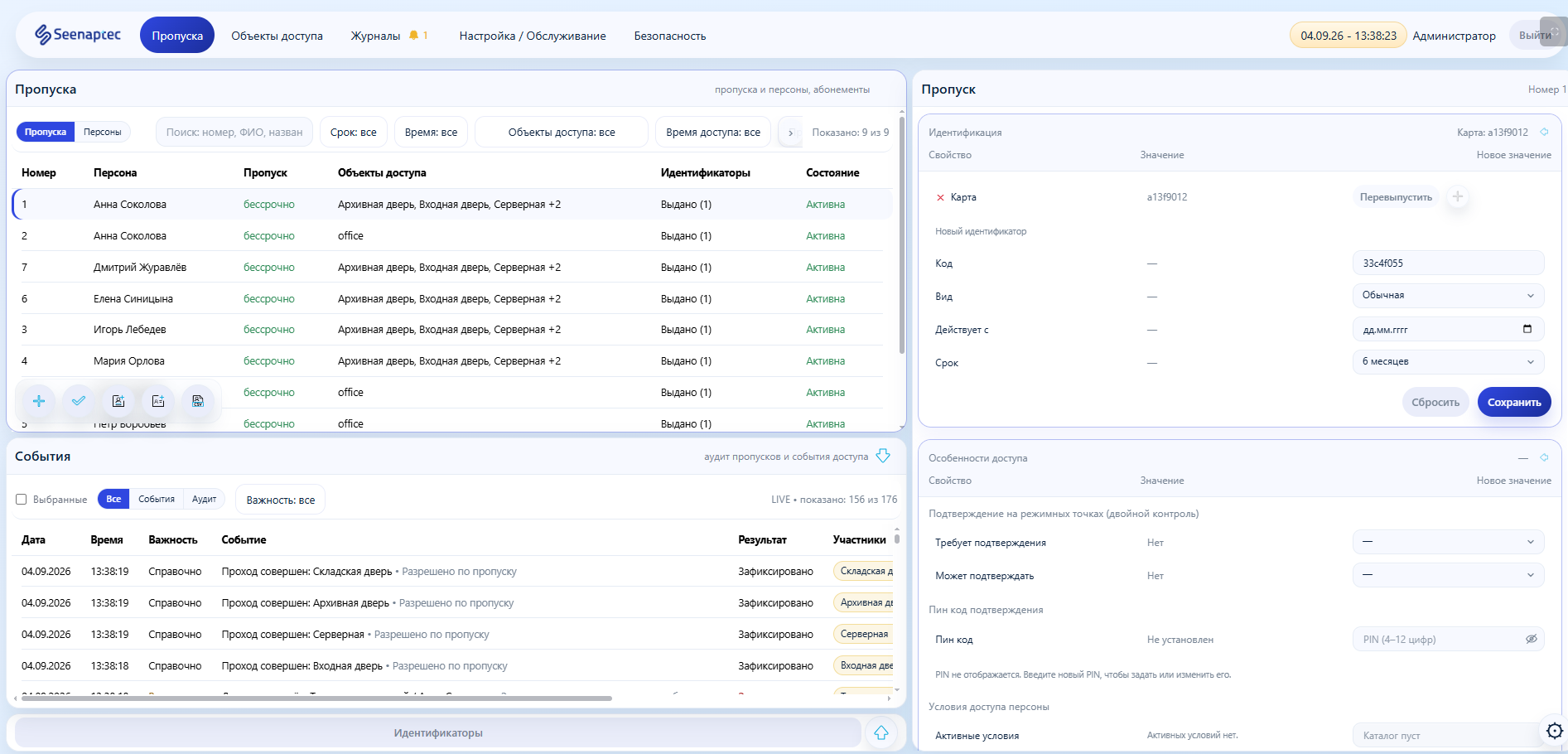
In Seenaptec, the person, identifier, and access right are separate. A card or PIN is a means of identification, while rights are set by a separate pass: who is granted access, to which objects or routes, for what period, and with what restrictions.
Cards and PINs
The identification module supports the use of cards and PINs, including combined modes.
Various identification modes can be used at an object: card, card + PIN, as well as scenarios with additional confirmation.
Presence and Working Time Tracking
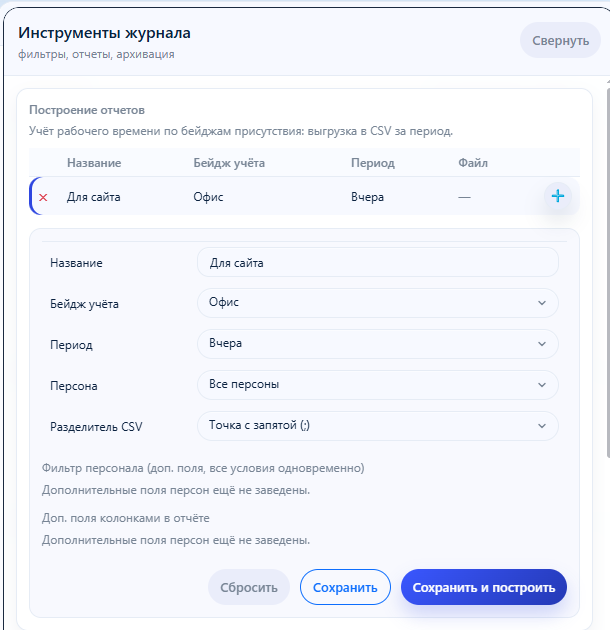
Seenaptec records the intervals of persons' presence in designated zones and sessions of work with objects.
An accounting zone is linked to access objects, and the system automatically generates presence intervals based on registered entries and exits. Reports on time spent can be built based on these events.
Hardware and Service Monitoring
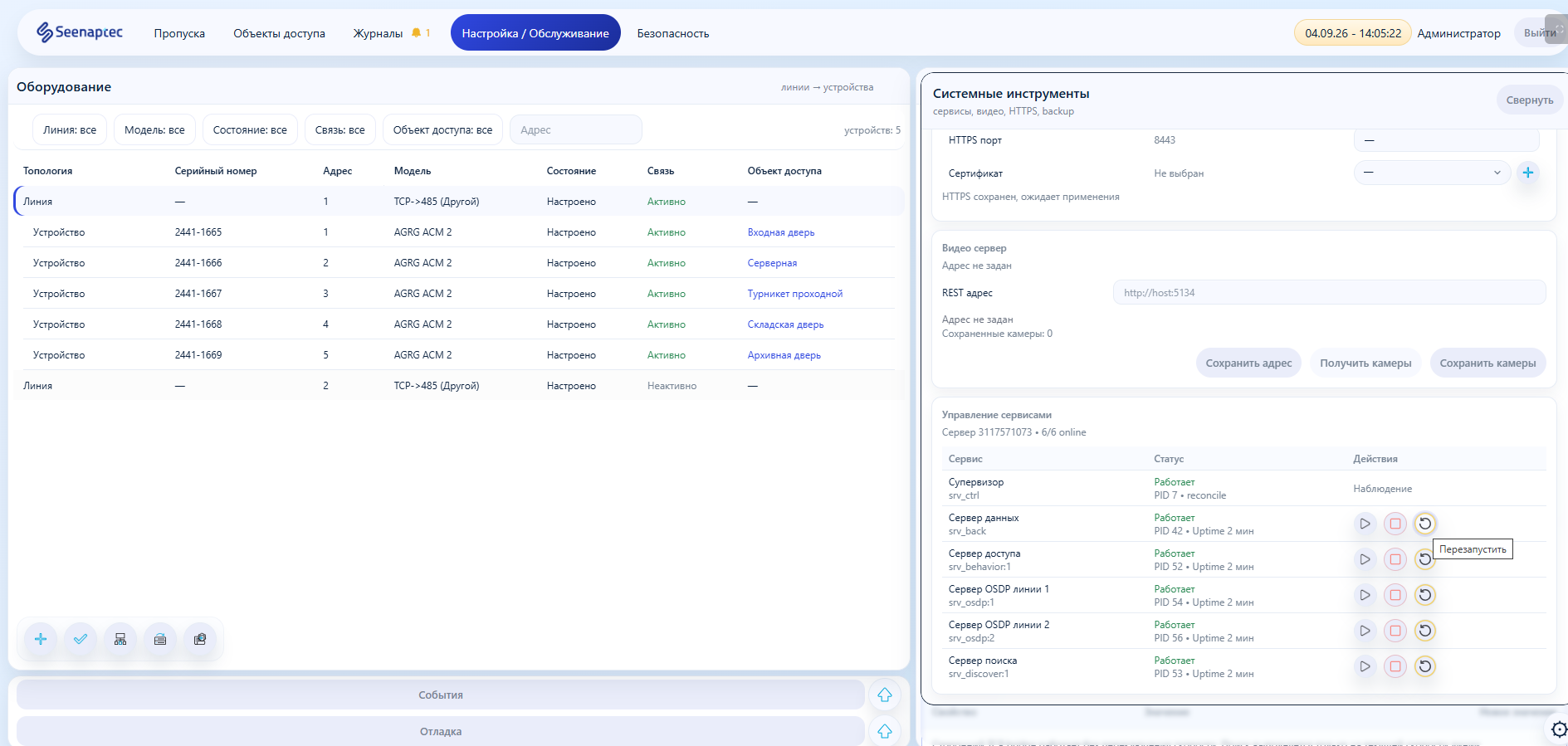
An engineering module for monitoring the state of the system.
Seenaptec shows the state of server services, OSDP lines, devices, communication, and backup circuits. Server services can be started, stopped, and restarted from the interface; the actual execution of operations is confirmed by technical state events.
Advanced Modules
Conditional Access
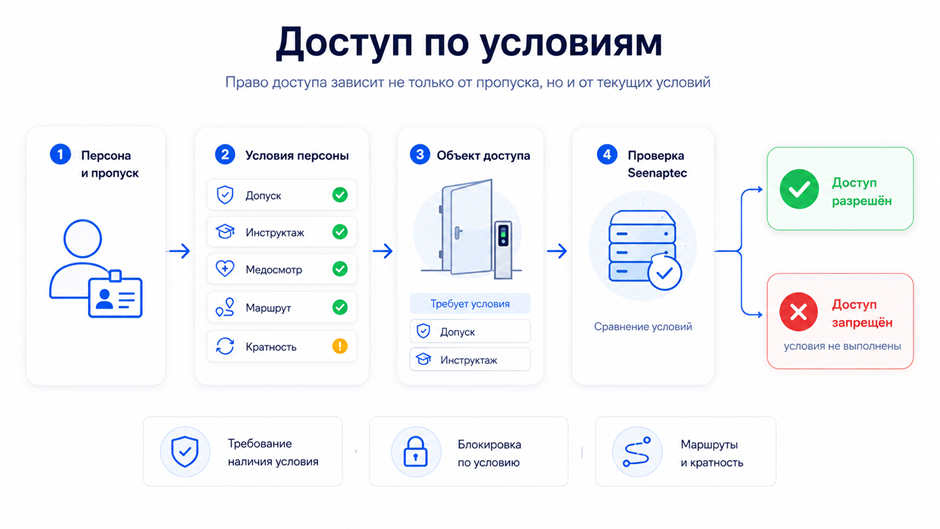
The module allows access decisions to be made not only based on a valid pass, but also on current conditions related to the person. For an object, you can require the presence or absence of a certain attribute — for example, completed briefing, valid clearance, or medical examination.
Conditions can be set and cleared automatically when passing through certain objects. Movement routes, limiting the number of passes, and zone presence control are built on the same logic. Thus, the access right can change dynamically depending on the person's actions inside the facility.
Applications: production, hazardous and restricted areas, contractors, medical examinations, briefings, sequential admission by route.
Escorted Access
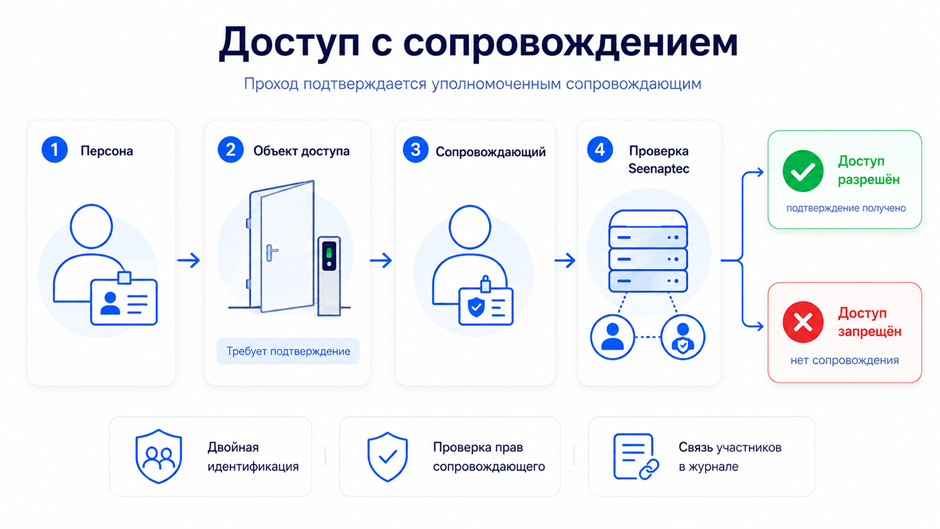
The module implements scenarios in which a visitor's or employee's right to pass must be confirmed by another authorized person.
After the main person presents their identifier, the system waits for the escort's identifier. The confirmer must have the appropriate right and their own valid access to this object. Seenaptec links the participants of the pass and records the result in the log, so that later it is possible to determine not only who passed, but also who confirmed their access.
Applications: visitors, contractors, restricted rooms, dual control, work only in the presence of a responsible employee.
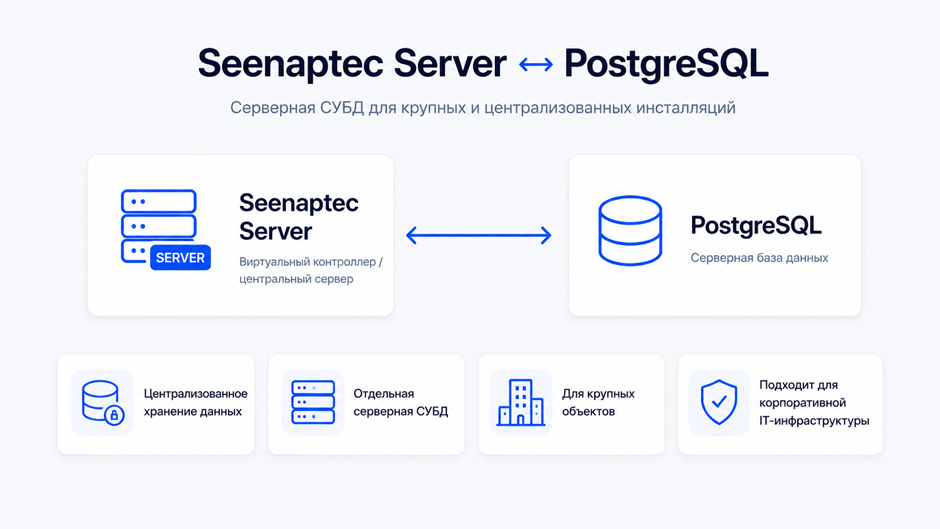
Personnel Type Management
The module allows you to create different person types and define a custom data structure for each type. For example, employee, visitor, and contractor cards can contain different sets of fields and be used in different access processing workflows.
In addition to basic data — name, photo, and status — organizational, contact, service, and other fields can be added to the card. This allows the Seenaptec personnel model to be adapted to the enterprise structure without developing a separate card index.
Applications: enterprises with employees, contractors, visitors, temporary personnel, and other categories of access subjects.
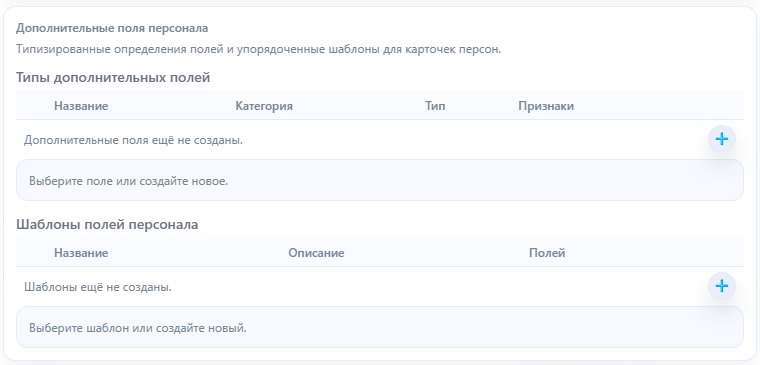
PostgreSQL
The module adds support for the server DBMS PostgreSQL instead of the built-in SQLite file storage.
This deployment is intended primarily for large and centralized systems where the database must operate as a separate infrastructure service and serve the virtual controller or central Seenaptec server. In the price list, PostgreSQL is separately available for the Basic edition and included in the Professional edition.
Applications: large facilities, corporate data centers, centralized systems, projects with requirements for a server DBMS.
Historical Event Archiving
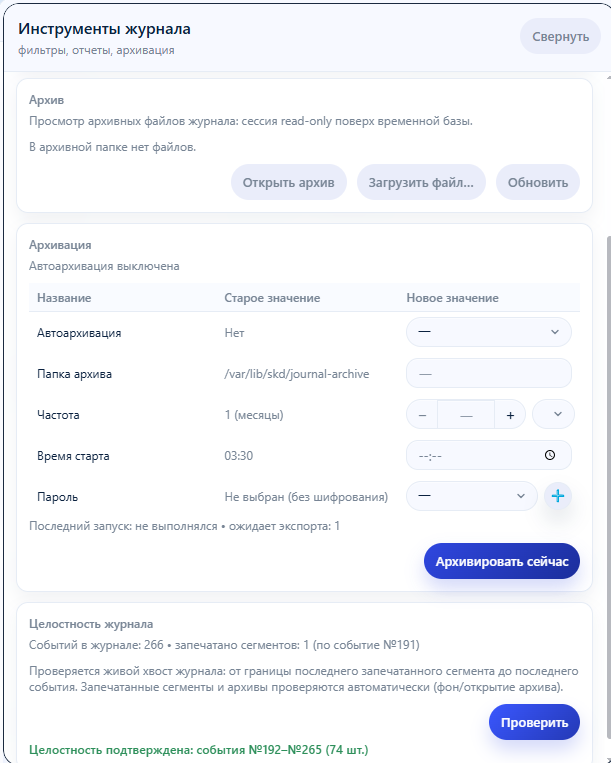
The module is designed for long-term storage of Seenaptec history outside the main operational database. The platform can automatically generate log archives according to a schedule, store them on the server, and encrypt them if necessary.
The archive does not become a set of "dead" files. It can be reopened directly in Seenaptec: the system checks the integrity of selected segments and provides the familiar event feed, filters, and record cards in archive viewing mode.
The history is additionally protected by an integrity control mechanism. Log records are linked in a hash chain, thanks to which the platform can detect content modification, insertion, or deletion of events.
Applications: long-term event storage, investigations, audit, facilities with requirements for history immutability control.
Data Import
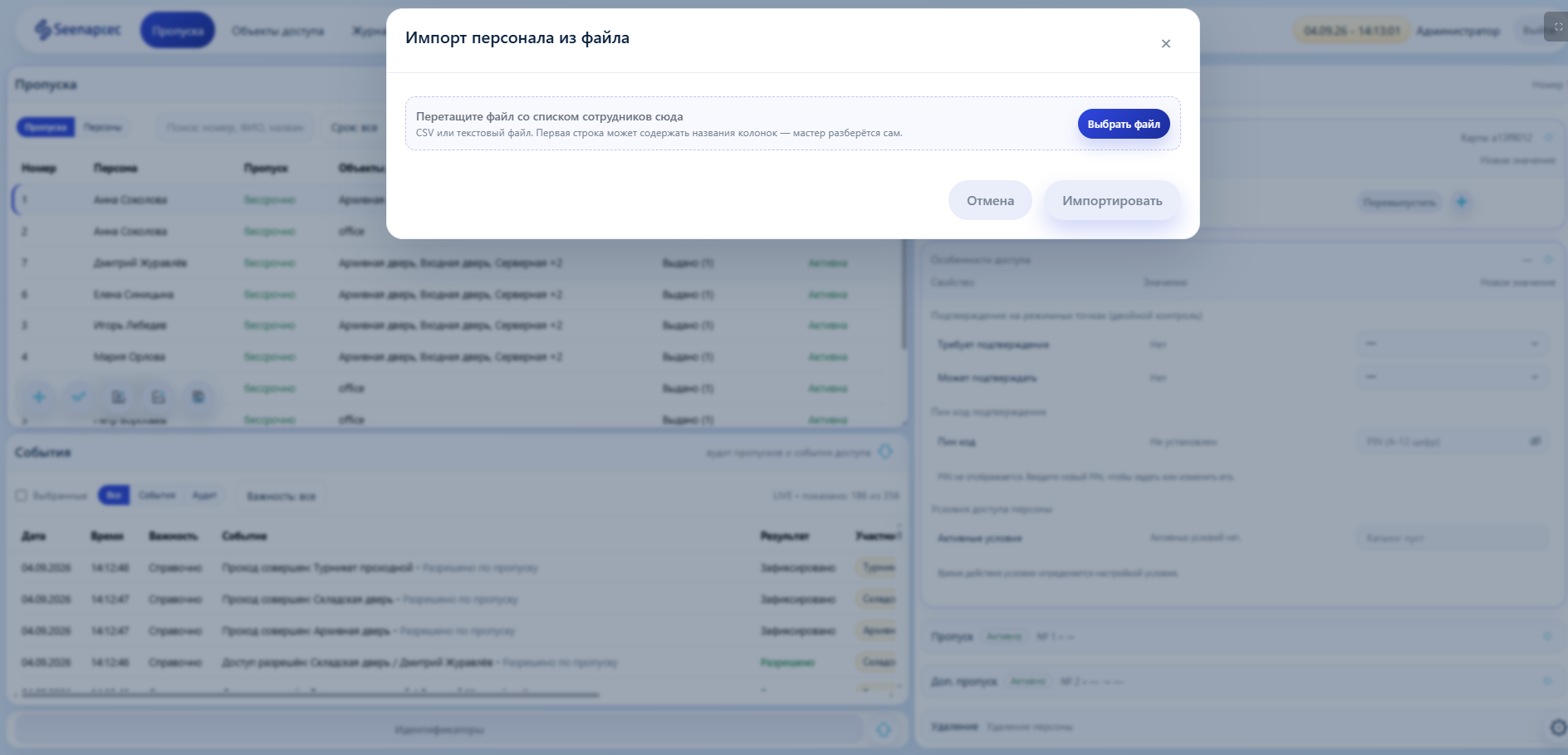
The bulk data entry module allows you to load personnel and hardware information from CSV files instead of manually creating large numbers of records.
When importing personnel, Seenaptec shows a preview of the table and allows columns to be mapped to full name, cards, and additional fields. Existing records can be identified by external identifier or already issued card and updated without creating duplicates.
Import is especially useful during initial system startup, migration from an old ACS, or regular loading of data from corporate directories.
Applications: migration, large personnel databases, initial system commissioning, bulk hardware loading.
White Label / Branding Pack
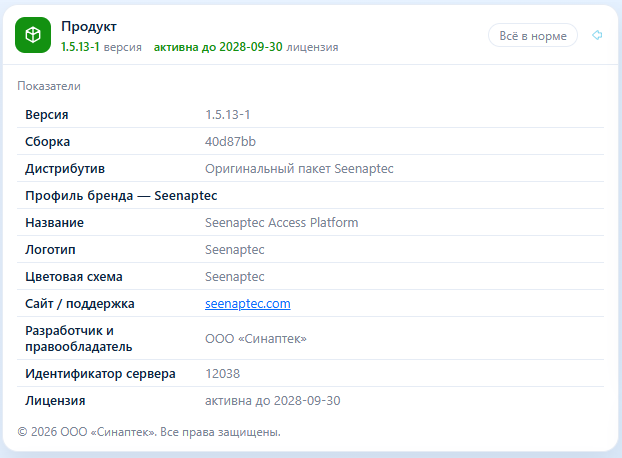
The module allows the Seenaptec user interface to be adapted to the corporate style of the customer or partner without changing the functional logic of the platform.
Custom interface design and visual identification of the solution can be used. This option is suitable for OEM projects, corporate platforms, and industry solutions that should be perceived by the user as part of the customer's unified information environment. The copyright holder of the software remains LLC "Synaptec".
Applications: OEM, large corporate customers, integrators, proprietary industry solutions.
Administrative Access Recovery
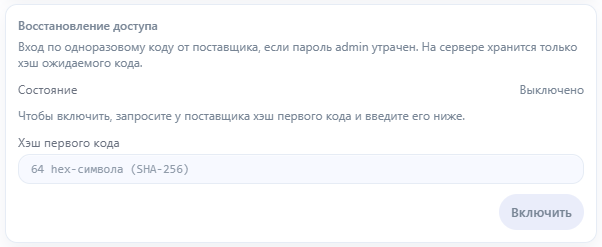
The module provides a backup mechanism for recovering access to the system in case of loss of the administrator password or deletion of the administrative account when no other operator with full rights exists.
The function must be enabled in advance by the administrator. A one-time code issued by the supplier according to the established procedure is used for recovery; only the hash of the expected value is stored in the system itself. After the work is completed, the mechanism can be completely disabled again.
This allows a controlled emergency recovery channel without creating a permanent backup account or universal password.
Applications: critical infrastructure, remote facilities, systems with increased requirements for recovery from administrative error or sabotage.
Specialized Objects
Server and Telecom Cabinets
A specialized access object for server racks, telecom, and technological cabinets. Seenaptec treats working with a cabinet as a long session rather than a single lock opening event.
For a single-door cabinet, the system records the start of work, the last activity confirmation, and the end of the session. In a two-door configuration, the front and rear doors belong to one object: opening either side starts a common session, and it ends after both sides are closed. At the same time, the opening side is saved in events and the object state.
This model makes it possible to answer not only "who opened the cabinet", but also "who is currently working on it and how long the work has been in progress".
Applications: data centers, server rooms, telecom nodes, engineering and technological cabinets.
Barriers and Vehicle Points
A specialized object for controlling vehicle entry and exit. Seenaptec models a barrier as a full-fledged access point with separate directions of movement, rather than as a simple actuator output.
The object can include entry and exit readers, barrier drive, and sensors of actual passage. Safety and barrier position sensors can also be used. The log records not only the open command, but also the result of the vehicle's passage.
Applications: enterprise territories, parking lots, logistics facilities, industrial sites, and vehicle checkpoints.
Doors and Turnstiles
Doors and turnstiles are the basic passage objects of Seenaptec, but their number can be expanded with additional licenses depending on the platform edition. In the system, these are full-fledged software objects with their own functional slots, modes, and rules.
A door can use readers, a lock, an exit button, a position sensor, and an emergency entry. A turnstile has independent entry and exit directions, its own actuators, and a passage sensor, thanks to which Seenaptec distinguishes the command to pass from the actually completed passage.
Applications: standard passage points, checkpoints, office and production buildings.